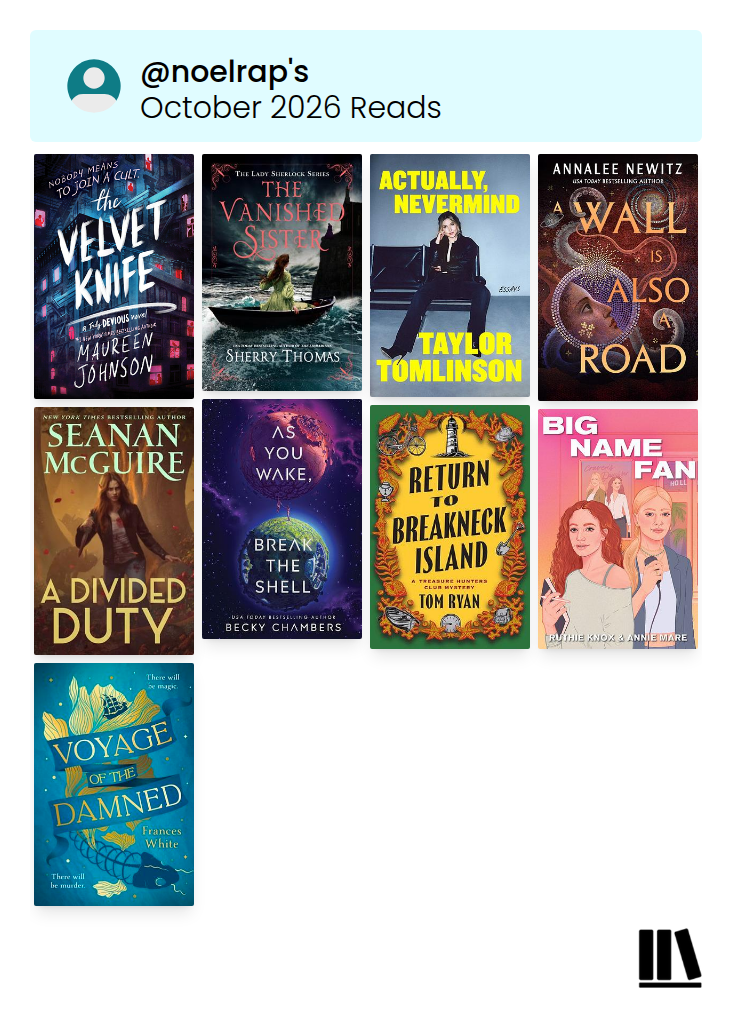
October 2026 Books of the Month
Posted on November 15, 2026
October 2026 Books of the Month
I read nine books in October, and we’re going to talk about somewhere between seven and nine of them depending on my stomach for posting reviews that are kind of mid. (The books are mid, I mean, not my reviews. If I lost my stomach for posting reviews that were mid none of these posts would exist…) We’ve got my favorite fiction book of the year to date on this month, for sure. Here goes.
The Velvet Knife — Maureen Johnson
Stevie Bell Mysteries, book 6
StoryGraph Rating: 3.78 (8th of 9)
My Rating: Single (7th of 9)
The first three books in this series were a trilogy of puzzle mysteries, and the next three have been more-or-less standalone. This one in particular — well, Johnson describes it as a fair-play mystery, and that’s true, but the part of the book that is a fair-play mystery is just a small part of the whole. A lot of the book is focused on what we might call YA novel beats: Stevie handling a breakup, fighting with her parents, managing her friends. Not to mention the backstory, a cold-case from the 1970s about a high-control commune which has a body count, and which leads to a body count in the present day.
I get that there’s a weird bind with a teenage detective, where you can’t keep having murders in the high school unless this is Buffy and you are actually on a Hellmouth. The last two books had Stevie get called in to deal with long-cold cases, which is a way out of the Murder, She Wrote of it all, but since each of those cold cases wound up with a modern-day body count, including this one, Stevie is starting to feel the burden of bringing death to every puzzle she pokes her head in.
Having spent an inordinate amount of time listening to Johnson on the Says Who podcast, this book does kind of read like “Maureen’s Obsessions: a Novel”. That’s not a bad thing, her personal interest comes through on the page. I still find Stevie pretty compelling as a character, but the other high-school characters are a bit thin in this one, since they have to kind of fit around both the modern-day mystery and the flashback story.
Supposedly, there’s one more book in this series, and I’m curious as to how that wraps up.
The Vanished Sister — Sherry Thomas
Book 9 of the Lady Sherlock Series
StoryGraph Rating: 4.01 (5th of 9)
My Rating: Double (2nd of 9)
I realize this might make it sound like I didn’t enjoy the Stevie Bell novel, but I wanted to meander a bit about mystery book structures. Your classic detective mystery novel generally starts with the detective being called upon in the first few pages of the book to solve a crime that has already happened (the Hawthorne/Horowitz books are like this, more or less). The classic amateur mystery novel spends a little more time to establish the characters and why the amateur is called upon to solve a crime. but generally the crime happens then about a third of the way in or so. This book is structured as an amateur mystery. Even though Charlotte Holmes is a professional detective, there are personal ties between the characters that make this crime important, so structurally, it’s an amateur detective novel.
Obviously, there are grey areas here — the crime in The Silent Appeal happens almost 80% of the way into the book, but we’ve been primed by the text to know that something is coming. The Velvet Knife is weird here, the event that moves this from “some ominous things are happening” to “Stevie starts investigating” happens about 40% of the way in, but the actual fair-play murder death, at the risk of being spoilery, happens at about the 2/3 mark. And the fair-play murder is acknowledged in the text as being kind of tangential to the main plot. (The fact that a lot of the book is a flashback does complicate this analysis a bit). Which is where I get the sense that Velvet Knife is a YA-breakup novel that also includes a crime story. Again, a description, not a criticism.
Nerdy genre-structure analysis aside, I like the Lady Sherlock series, I love the conceit — that Charlotte Holmes, a young, pretty, hedonistic woman, has invented the older, plain, ascetic Sherlock Holmes as a fiction to allow her to participate in society as a detective. For a while there the books got very lore-heavy as Charlotte fought her Moriarty, but we’re now three years later, and things appear to have settled down.
There is, of course, a story in this book. In Charlotte’s world, Watson is Mrs. Watson, Holmes’ older friend and sort-of patron, and in this book we meet Watson’s estranged sister, now a fancy Lady who heretofore has not deigned to associate with her more disreputable sibling. In the setup, Watson is invited to visit her sister at her fancy mansion, somewhat out of the blue. This visit is complicated somewhat when the sister vanishes (which you might have guessed from the title), and even more so when a body is found which almost, but not quite, matches the sister. Miss Holmes gets involved and we are off.
This series is at its best when it combines solid mystery bits with commentary on Victorian England, and this book brought both. The mystery of who has actually died and why and what relationship it all has is twisty, with some solid detectiveing. It’s always funny that Holmes in this telling loves both food and sex and after several books of pining, it’s also nice to see her and Lord Ashton in a happy and somewhat stable place. It just narrowly missed a triple because like a lot of mysteries I’ve read recently a) at least one of the crimes is coincidental, accidental, or committed by someone not of sound mind, and b) there’s a big lore drop at the end. .
This isn’t the place to start the series, but you should start it.
Actually, Nevermind — Taylor Tomlinson
StoryGraph Rating: 4.15 (3rd of 9)
My Rating: Double (4th of 9)
A book of essays by a standup comic is often made up largely of their performed bits, somewhat awkwardly translated to a page. Without the craft and timing of the performer, they can fall flat.
Acutally, Nevermind is (mostly) not that. The hook here is that the essays are about things that Tomlinson has changed her mind about — church, her sexuality, her mental health, and so on. And while her standup does cover these topics, the essays here feel a little more personal and less setup/punchline than her stage act.
I liked this more than I expected. I’ve seen Tomlinson’s Netflix specials, and I would have been okay with that, but a bit more. What I got was beyond that, a pretty solid near-memoir.
A Wall is Also a Road — Annalee Newitz
StoryGraph Rating: 4.12 (4th of 9)
My Rating: Single (6th of 9)
Marketed as:
“A thought-provoking and heartwarming novel about science, the meaning of life, and love, perfect for fans of Becky Chambers, Ryka Aoki, and Martha Wells.”
That blurb is worth unpacking a bit. You have two authors that are significantly more well-known (based on the number of Amazon reviews). That said, the Aoki book (Light From Uncommon Stars) is a pretty good comp — mundane first contact, LGBTQ+ representation, a tone that allows for some goofiness but also some darkness. I probably wouldn’t have paired them myself because Aoki’s book is contemporary and Newitz’ takes place in Pompeii, but I see it. The other two are basically “popular and cozy-adjacent”, put ‘em all together, and it’s not a bad gloss of the general vibe.
Our main character is Gardenpath, they are a sentient slime mold. Actually, they are a graduate student sentient slime mold, who is doing research on life in a part of the galaxy that is not supposed to have any life. A small rock, the third rock from the sun, so to speak. Gardenpath calls it “Tentacle”, where they start to interact with the native life forms, which are much more conscious than Gardenpath’s scientists think multi-cellular life can be. Gardenpath even learns that the nearby city is named Pompeii. Yes, that Pompeii (as featured in Newitz’ earlier book Four Lost Cities).
So we have two tracks — in one, Gardenpath is trying to graduate, which involves turning his work into something original, but not so original that the abusive scientists who run the joint get upset and kick them out. In the other, Gardenpath meets a woman named Murtis, who is a sex worker in Pompeii, and they learn about each other and eventually fall in love.
Every year I have at least one book that gets my sardonic “if you only read one” treatment, as in: “if you only read one book this year where a sentient slime mold tries to save their human lover from the eruption of Mount Vesuvius, make it A Wall is Also a Road”. It’s not your everyday book, is my point.
I went back and forth on whether to single or double this one, and honestly, seeing the rankings this month, I’m still struggling with it. On the good side, Newitz knows their stuff, both the Pompeii bit and the academic trauma bit, and the writing is light-footed. It’s genuinely hard to have a narrator who is so far from human that basic concepts need to be translated, but for the most part, the book pulls it off (at the cost of the first third being a little slow). There’s a great bit where Gardenpath reveals to Murtis that they are from the stars, and Murtis basically shrugs and says “are the Romans trying to conquer there, too”.
My main downside is spoilery and is basically that both stories end anticlimactically. On the slime mold side, after a whole book of how scary and powerful their advisor is, he basically crumbles the first time they throw a real punch. On the Pompeii side, it just kind of ends? There’s a nice heart-to-heart at the end, and then Gardenpath hides the location of Tentacle to prevent them from being used by slime-molds, but it’s not clear that they ever tell Murtis they aren’t coming back? I either missed something, it’s meant to be ambiguous, or it’s a little underwhelming. .
So in the end, I went Single, but I reserve the right to change my mind. It’s a very ambitious book, the fun parts are a lot of fun, and I wish I liked it as much as I admire it.
A Divided Duty — Seanan McGuire
Book 20? Something like 20 of October Daye series
StoryGraph Rating: 4.21 (2nd of 9)
My Rating: Double (5th of 9)
Look, this is the 20th book of the series (the SG score clearly shows that people that didn’t like this series have long since bailed), large parts of it refer back to book three, published fifteen years ago, and yet I did not feel like I had to dig through a fan wiki to follow along. The cost is that the book can sometimes feel a bit didactic, as McGuire errs on the side of explaining stuff even if you might actually remember it, but on the whole I prefer overexplanation to having to consult an encyclopedia.
This time around, Toby is called upon to defend the newest member of her household — Raysel. Raysel is one of several characters in this series who are villains in the first few books until we learn that they have all been manipulated by the real villain of the entire saga. We get a drive-by of that person’s current resting place, just to keep her top of mind for whatever is coming when McGuire deicides to finally wrap it all up.
I like this series, the characters are interesting, the banter is good, the plots are generally satisfying, this one is on the high end of the series, I thought. It focuses on a relatively straightforward story and relatively unconvoluted lore. The main issue for me was that we’re supposed to care about Raysel the way Toby has come to, and because the way the last few books have played out, most of Raysel’s character work has happened offscreen. Also, Toby is running out of beloved figures from her youth to be betrayed by.
So, I have this one a double and A Wall is Also a Road as a single, and I’m not even sure I believe that. I did enjoy this book (and the attached novella) quite a bit, and it just barely passed the “would I recommend this if I had half the time” test (though partially because I’m invested in the series), where AWiAaR (I love turning titles into awkward acronyms) maybe just didn’t. But AWiAaR is unique and weird in a way this book isn’t, and that should count for something.
As You Wake, Break the Shell — Becky Chambers
StoryGraph Rating: 4.54 (1st of 9)
My Rating: Home Run (1st of 9)
Marketed as:
This one has an SEO subtitle, too: “A Heartfelt Science Fiction Romance of Found Family and Stubborn Survival”, and what’s weird about that is that while the book is heartfelt and I suppose a romance (though it deliberately skips normal romance novel plot beats), it’s not really found family or stubborn survival (stubborn, I’ll grant you). I would consider a “found family” to need to go beyond just “a new romantic partner who has some friends”… just some weird choices from the marketing team.
I should note up front that this book is the first half of a duology, and it very much ends in the middle. Well, one of the timelines does…. (And I suspect the second book will have more of both found family and survival.)
It took me a good 72 hours to figure out what song my brain was singing this title to, and it turns out that “As You Wake, Break the Shell” scans to “Just You Wait, Henry Higgins” from My Fair Lady. Aren’t you glad I shared that?
As I’ve established here across the last several years, I’m a huge fan of Becky Chambers work:
- Her first novel, A Long Way to a Small, Angry Planet, I didn’t love at the time, but have re-read multiple times since.
- I didn’t rank books in 2016, A Closed and Common Orbit would likely have been top three, top five at worst. That book is quite special to me in part because of when I read it.
- I didn’t rank books in 2018, but Record of a Spaceborn Few was granted “The Terry Pratchett Award for being just really goddamn human about your characters”
- To Be Taught, if Fortunate was 20th in 2019
- A Psalm for the Wild-Built was 10th in 2021
- The Galaxy and the Ground Withinwas my favorite book of 2021
- A Prayer for the Crown-Shy was 6th in 2022
And as a sidebar, how does she have book titles that are like nobody else’s book titles and always sound like the beginning of a poem?
Which brings us to As You Wake, Break the Shell. Our viewpoint characters are Signy and Cora. They live on a nightmarish dystopian colony world, where the human settlement clings to a series of rafts on a lake on a crater of a world with perpetual seismic activity and constant acid rain, among other charms. The world building of why this world exists is well-done, and I won’t spoil it much except to say that in the author’s note, Chambers cites a book on ethical space colonization and says she did the opposite. We see Signy and Cora in two timelines. In the earlier timeline, Signy grows plants with a sideline in creating and distributing underground medications, and Cora is a pilot, riding a tamed space animal to and from the local moons for supply runs. We almost immediately also see them fourteen years later, together, happy, but with their situation very much changed.
We go back and forth between the timelines, with some not-subtle but nicely done tie-ins back and forth — we see the origin of a hobby after we see the hobby. We get hints of things we haven’t yet seen in the past. It’s pretty effective, not least because it causes us to focus on the parts of the story we don’t know rather than the parts we can guess, like whether Cora and Signy get together.
Similar to The Galaxy and the Ground Within, the actual plot for the first 80% of so seems to have very little going on. Like GatGW, it is nonetheless riveting because Chambers’ writing is so precise and interesting. Like GatGW it’s quietly setting up background scaffolding, and like GatGW everything happens at once at the end.
This book blew me away, and some of the reasons why are spoilery. But the characters are fascinating, and the world is so well drawn. Part of the setup here is that these characters have full access to an Earth library, so even though they have never seen, say, an elephant, they know what elephants are. Chambers gets a lot of mileage out of this, both in good banter between the characters and also as a way to say a lot about the world by contrast and by what isn’t said. I think it’s fair to say that the weight of unsaid implications about the world comes crashing down at the end as we are forced to reconcile with the idea that, as much as Cora and Signy are mad about their situation, they are not nearly mad enough.
This book blew past my “I want to read this out loud” filter, to “I want to put some of these phrases on posters”. There are some moments here that are just gorgeous and unexpected, and sweet, and funny, and enraging. It’s just astonishing.
I have, I think, only modest illusions about my skill as a writer. I think my technical writing is clear and easy to read. I think I have a decent sense of rhythm in prose. (And a terrible sense of rhythm in life.) I used to even be funny, though 25 years of writing in a field where jokes get taken out by your editor seems to have taken its toll. But I’ve tried writing fiction and, y’know, I’m not good at it.
Which is to say, if I could do what Becky Chambers does, I’d probably never stop writing. I think that about other things I can’t do, if I could play piano like Billy Joel, or draw like George Perez did (to pick two at random). If I could create such beautiful art and have it seem so effortless — which I know that it is not…
Gorgeous cover, too.
Return to Breakneck Island — Tom Ryan
Book Two in Treasure Hunters Club Mysteries
StoryGraph Rating: 3.94 (6th of 9)
My Rating: Single (8th of 9)
We pick up the action in the small town of Maple Bay, Nova Scotia, about a year after The Treasure Hunters Club. Cass has somehow written and published an entire book about the Treasure Hunters in a year. Dandy is now sixteen, and Peter is selling the mansion where he was SPOILERED and turning it into a big foundation. Separately, they each learn about the mystery of Breakneck Island, a spot of land a short, but dangerous boat ride away from the town, where a family went missing during or after a big storm in 1932. Cass sees this as a potential new book, Dandy as a potential family obligation, and Peter as something of an adventure. We also see the 1932 events in flashback. The adventure becomes somewhat more urgent when the local woman who has been trying to instigate an investigation dies in an “accident”.
This continues my weird trend of reading sequel mysteries where the goal seems to be to hang out with a bunch of characters who are sort of tangentially involved with a mystery. That’s a little less true of this book than some of the others. The viewpoint characters interact with each other far less in this book than the first one, meaning the books is basically split into three stories (four, if you count the flashbacks), which kind of keeps the plot from getting complex. Especially since we spend three chapters at the end after the murder is solved setting up book three (presumably).
There are a couple of dividing lines between “mystery” and “thriller” and I think one of them is whether the big reveal is the detective figuring out the identity of the criminal or is it the criminal announcing themself to the detective. I’ll also note that the 2026 characters eventually find out what happened in 1932 by the simple expedient of finding somebody who knows what happened and asking. (No clever POV tricks in this one…)
All of which is probably harsher sounding than I mean to be. The town is charming, and the characters are interesting to hang out with. The setup for what I assume is book three actually potentially resolves one of my biggest problems with book one.
Big Name Fan — Ruthie Knox, Annie Mare
StoryGraph Rating: 3.33 (9th of 9)
My Rating: Single (9th of 9)
Marketed as:
“A perfect story for every Rizzoli and Isles fan who rooted for the leads to get together, this new novel is also ideal for fans of Only Murders in the Building and books like Spoiler Alert” — Spoiler Alert is a romance novel about a fanfic writer who meets her celebrity crush, so it’s tangential but a signifier of “we’re going to treat fan stuff respectfully”. The other ones are basically spot on, the book is “what if Rizzoli and Isles, but way more popular, and the leads are both gay, and they solve a cold case murder of their old makeup artist”.
I read this because of how much I enjoy the Prairie Nightingale books by the same authors. This book has its charms, but it’s not quite as good. In part because I think Knox and Mare are much more convincing writing about “people who live in Wisconsin” than “famous TV stars”, some of the TV stuff stretches credulity a bit.
This is actually a pretty good double-feature with Abbi Waxman’s Mason and Mann Mysteries, both have a Hollywood backdrop and very strong feminist themes.
Voyage of the Damned — Frances White
StoryGraph Rating: 3.92 (7th of 9)
My Rating: Double (3rd of 9)
Marketed As:
“The TikTok sensation from the UK has come to North America!
A mind-blowing murder mystery on a ship full of magical passengers. If Agatha Christie wrote fantasy, this would be it!”
So… “TikTok sensation” is it? Sure, sure. Look, marketing department, I see what you are trying to do with “if Agatha Christie wrote fantasy” but there’s a reason why the common form is “for fans of Agatha Christie”…
Anyway, we are in a fantasy empire split into twelve provinces, the inhabitants of whom seem to barely interact and never inter-breed. They all have different distinctive hair colors, though there’s no way I remember which is which, and they all have very distinctive cultures. There’s the warrior province, and the province of sneaky spies, and the bookish province, and the poor province that just provides cheap food. And you get the idea… it’s giving YA vibes for a book that isn’t really marketed as YA.
Each province has a ruler, who has a magical Blessing, which is some kind of very specific magical power, except the emperor, who has all the magic powers and is basically god-like. Once a generation, each province’s Blessings transfer to a random offspring of the current Blessed, and the twelve new-ish Blessed go on a cruise together. (I cannot remember what the ostensible point of the cruise is, it’s some kind of religious pilgrimage).
Our hero is Ganymedes Piscero — Dee, to his friends. He’s the Blessed of the aforementioned poor fish province, and as such the other Blessed all consider him to have the rough value of something that stuck to a shoe (so, basically nobody calls him Dee). But he is on the boat. Only one problem, which is that he has not actually been Blessed, but his father has been covering that fact up to hide the obvious implication that the Blessing has gone to some illegitimate child somewhere.
Dee’s plan is to make such an ass of himself on the trip that the other Blesseds will kick him out of the club, and he can stop lying to everybody about his magical status. This is thwarted almost immediately when the actual heir to the emperor dies in what is probably a murder. Shortly thereafter, a second Blessed is killed, and Dee decides he needs to figure out what’s going on in self-defense.
The mystery plot is surprisingly decent in this one — it’s not quite a fair-play mystery because of all the magic involved, but at the end of the day, everybody’s motivations made sense, the late plot reveals all worked, and it even pulled the hard trick of making something that might otherwise seem like a lucky break for the hero feel pretty motivated. The character story mostly works, too.
I have two big notes:
- There’s probably a name for this, but the book has a strong case of “our realm has been stable for centuries despite being so fragile that a strong wind could blow it over”. The magic system is actually kind of interesting, the rest of the world building is, as I said, kind of YA coded.
- The hero in particular, and to a lesser extent, everybody, all talk like modern-day Gen Z. Now, before you get angry with me, I largely don’t mind this. I understand why you’d make that choice, and there are solid representation reasons for using labels that are easily understood by the audience. That said, when Dee describes something as addictive “like crack”, I did bounce out of the story.