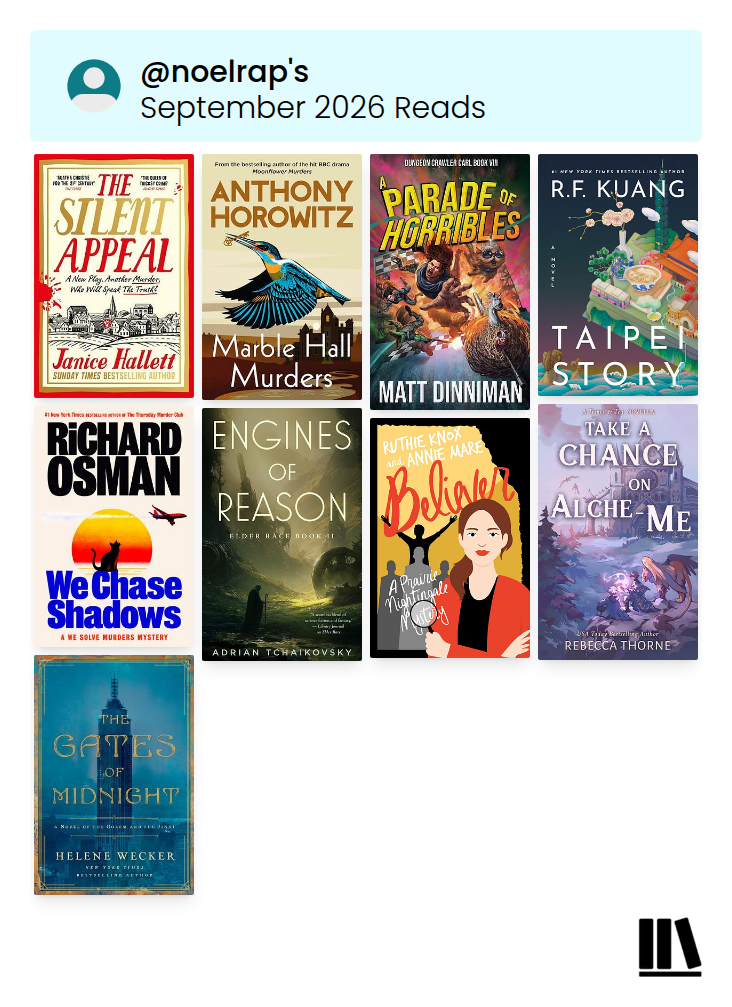
September 2026 Books of the Month
Posted on October 24, 2026
I thought I was in some kind of reading slump in September, in part because I DNF’d a book or two that aren’t on this list but it turns out I also was not counting the first book I read this month, which made me think I had read less than I had all month. Weird.
Anyway, I read nine books in September, and we’re going to talk about all of them unless I decide to skip one.
The Silent Appeal by Janice Hallett
StoryGraph Rating: 4.24 (3rd of 9)
My Rating: Double (4 of 9)
To get the logistics out of the way, Hallett writes mysteries that you experience via found media, typically email and texts between the characters. This book is the third in a series about a small community theater troupe in the UK that has a sad habit of having people die during their shows.
I’m a little limited here by spoilers, so I’ll say the following:
-
A side effect of the way Hallett tells these stories is that you experience events forward rather than backward — which is to say, a typical detective story starts with the crime and the detective has to piece together what happened. This story is in reverse, you see all the pieces and have to figure out what’s important when the crime actually happens on like page 300 or something.
-
I think you are going to have a better time with this one if you think of it as “oh, here are my old friends The Fairway Players, I wonder what shenanigans they have gotten them into the time” rather than “I am going to solve a puzzle mystery”. Hallett has a real gift for writing about the power dynamics of small groups with low stakes (other books have been about a recurring pub quiz or a small class of art students), but, again, without giving too much away, don’t expect to be bowled over by a master criminal at work or some such.
-
There’s a character in the first book whose whole deal is that she’s needy and doesn’t get social cues. When she showed back up here, I thought, okay, either we’re going to beat the same joke into the ground or Hallett is going to use our expectation and and the character is going to have become super-well adjusted. And actually she kind of does neither or possibly does both, but I thought the endpoint for that character was lovely.
-
I spent an inordinate amount of time trying to figure out how you might adapt Hallett’s books to another medium, and I’ve never yet figured out a way that they’d work on film, but I had the thought they could work on stage. Upstage, the two lawyers are nominally reading the messages and maybe making a murder board, but the actual vocal work is happening from the characters standing behind them (kind of Love Letters style) and maybe acting some things out? I think it’d basically work, but whether you could re-structure it into a compelling, like, 100-minute show, I’m not sure. One thing you’d have to make clear is the character reading the message is the character the lawyers think is the sender, which isn’t always the actual sender.
Marble Hall Murders — Anthony Horowitz
StoryGraph Rating: 4.10 (6th of 9)
My Rating: Double (1 of 9)
Book Three of Susan Reyland mysteries
Speaking of film adaptations, this series has a well-regarded BBC TV adaptation, and per the author’s note, one reason this third book exists is because the actress wanted to play the character a third time.
As we start, Susan Reyland is back in London, where she has been hired to edit a post-death-of-the-author continuation novel starring unfortunately-anagrammed detective Atticus Pünd. Good for her! The new author has apparently leaned into the old author’s habit of using the books to create unflattering charactures of people he knows and to freely seed hints about past deaths. Less good for her!
This time, the author is hinting at the death of his grandmother, the creator of a beloved children’s book franchise that is Legally Not “The Borrowers” or “The Littles”. The in-book franchise is called “The Little People”, which very much makes me wonder if “The Littles” was just a US-only knockoff of “The Borrowers”. I digress.
I can’t help but come back to the degree of difficulty here, again, two complete murder mystery novels we have to care about, plus a connection between them which has to be different than the connection between the last two. And it works again (I have some quibbles that would be really spoilery). But this was, I guess my favorite book of a month that didn’t really have a favorite book.
A Parade of Horribles — Matt Dinniman
StoryGraph Rating: 4.49 (1st of 9)
My Rating: Single (5 of 9)
Book 8 of Dungeon Crawler Carl
I feel like putting together all my Dungeon Crawler Carl reviews is going to tell a story of a sort.
There are a few things I don’t think I’ve quite said yet:
A thing that I think Dinniman does extremely well is adjust the story as the scope scales. What I mean is, that if you go back to the beginning of the series, Carl is continually worrying about levels, stats, loot, ranking, the nightly recap show, catching the attention of the AI, puttering in the safe room with new gizmos and such. That was one of the key attributes of the series early on, but as Carl has gotten more powerful and the scope of the stories has widened, Dinnimen has gradually pushed that stuff aside, trusting that the reader now understands the mechanics of the world well enough to focus on larger issues.
One of the many odd things about this series is that it has basically no sex or romance, but tons of innuendo. A lot of it is… I guess you’d say crude? I think the way to position it is that Dinniman is trying to make a point about how dehumanizing and lowest-common-denominator the dungeon is, or at least that’s the most sympathetic spin on it I can think of. I kind of wish he did this about 10-25% less, because I think rather than of contrast the dungeon AI with the crawlers, which I think is what Dinniman wants, it sometimes overwhelms the story.
I suppose it’s a little spoilery to explain why, but the pacing and structure of this book are bananas. It’s much more stripped down than the last book, Carl typically has a very tight short-term objective and a limited number of adversaries at any time. I did think the pattern of “figure out the big boss, figure out the traps, work around them, cause new problems” was managed particularly well this time.
Per Dinniman, there are two books left in the series and I can think of three reasonable places to place the book break. (My guess is next book is one level, the last book is end of the line). I can see what Carl’s plot victory looks like, but I still have no idea what his story victory looks like, in part because Carl is still kind of the blank at the center of the book.
Taipei Story — R.F. Kuang
StoryGraph Rating: 3.78 (9th of 9)
My Rating: Single (7 of 9)
Okay, first off, this book has one of those weird SEO subtitles that don’t actually appear in the book, and are only there to show up in Amazon and Google search results. In this case, the Amazon title is Taipei Story: The Profound and Poignant New Novel from the Author of Yellowface and Katabasis. And… that’s weird? I feel like “profound” and “poignant” are the class of adjectives that you should not self-apply and are only meaningful when somebody else applies them to you.
I make fun of marketing blurbs here, but credit where credit is due, this book has a very good one, in that it clearly describes what the book is, and even makes it seem like it has more of a through line than perhaps it actually does.
To get one other thing out of the way before getting to the book. If you are lucky, you don’t know that there was a controversy about this book some months before its publication because at one point in this book, a character attends a piano recital and the musician is Israeli. That’s it. There’s no actual discussion in the book beyond that. But there was a whole online thing about it. Look, think what you want, I guess, but going non-linear because an author mentions that a character is from Israel is flatly over-the-line. I recently saw a video where a person was trying to convince me that the point was that the Westerners in the audience were just patiently letting the musician perform and it was a big geopolitical allegory. I find this tortured at best, for one thing there’s no indication that the audience is Westerners and for another… the book just isn’t that subtle. To the best of my knowledge — and I refuse to look this up — Kuang has not responded to this at all. I’d be willing to bet a shiny dime that the reason that this character exists is because when R. F. Kuang did her own personal tour through Taipei, she saw an Israeli musician and the juxtaposition struck her as interesting. If there’s a geopolitical message in this book — and I am dubious that there is — it’s that our US-based ideas of political axes don’t neatly map onto the situation in Taiwan.
Which — finally — brings us to the actual book.
Lily is a rising sophomore at Yale, who is attending a 10-week intensive Chinese language program in Taipei, even though her family history is from the mainland. Her goal is to achieve fluency and be more authentically Chinese, and she’d like to be able to have a real conversation with her grandparents someday.
Things go wrong almost immediately. The apartment is a dump, she doesn’t get along with her roommate, she becomes the topic of gossip, the program is not rewarding. In the middle of it, her grandfather dies, causing her to spiral over how she will not ever be able to speak to him, and also prompting her to learn more about her family. As best I can tell, a lot of this is based closely on Kuang’s life (to the point where Kuang ends the book with what seems to be information about her real grandfather). Kuang did a similar trip, but she was older than 19.
This is the sort of book that really brings home how futile it is to rate books. Is it well written? Yes, very much so in parts. The specificity of both the descriptions of Taipei and of Lily’s internal life are very well written. On the other hand, it’s kind of meandering. Did I like it? Maybe? If you graphed my rating of the book as I read it, it would go something like triple, double, single, walk, single, double, not sure. Am I glad I read it? Mostly, yes. Should you read it? Not sure, is this description compelling?
Kuang gets some of the weirdest online debate — I mean, she’s an Asian-American woman who wrote a wildly successful series before she was twenty-five, that explains a lot of it. Her books get accused of a) lacking nuance and b) being too academic. FWIW, I think a) is probably true of Babel and probably Poppy War (I didn’t finish it), and b) is likely a side effect of, y’know, writing about academia and academics. Also nuance and subtlety aren’t always a virtue.
We Chase Shadows — Richard Osman
StoryGraph Rating: 4.08 (7th of 9)
My Rating: Double (2 of 9)
Book Two in We Solve Murders
Not sure what to say about this. I had nearly forgotten anything that happened in We Solve Murders, but the book gets you up to speed quickly. This is tonally quite similar to the Thursday Murder Club books:
- Viewpoint jumps across multiple characters
- Slightly sarcastic narrative voice
- Main characters who have particular skills but are clueless in other areas
- Found family via crime-solving
The big difference is that these books are thrillers more than mysteries — yes, they solve murders, but the book structure is more toward the thriller structure. (Mystery: primarily focused on solving a crime in the past, thriller: primarily focused on preventing crime in the future. Obviously there’s a lot of overlap.)
Anyway, it’s entertaining and twisty, I don’t like the characters as much as the Thursday Murder Club crew, but that’s a pretty high bar.
Believer — Ruthie Knox, Anne Mare
StoryGraph Rating: 4.24 (4th of 9)
My Rating: Double (3 of 9)
Prairie Nightingale, Book 3
This is about as cozy as a mystery can get. There isn’t even a murder. Just a cult and some financial crimes, and a very competent group of women go after them in a very satisfying way. I wish I had something clever or fun to write about this, but I just think you should read it.
Take a Chance on Alche-Me — Rebecca Thorne
StoryGraph Rating: 4.18 (5th of 9)
My Rating: Single (8 of 9)
Part of the Tomes and Tea series
Thorne is self-publishing this novella, which takes place about several years after the end of the Tomes and Tea series. It’s a straight-up rom-com featuring Feo and Wyland, who were a will-they-or-won’t-they couple over the main series.
As this series picks up, they have moved into the “not any more, they won’t” column, they broke up and four years later they still aren’t over it and then romance novel things happen.
It’s recognizably the series, it’s cozy, well-done. Honestly, I was maybe a little more there for the glimpses of Rayna and Kianthe with their now six-year-old (they grow up so fast when the author can just flash-forward…).
The Gates of Midnight — Helene Wecker
StoryGraph Rating: 4.33 (2nd of 9)
My Rating: Single (6 of 9)
Book Three of the Golem and the Jinni
So, the last, like, quarter of this book, once all the pieces are in place and we reach the final boss battle, that part is pretty good.
I am reluctant to say this book is too long because it doesn’t repeat itself, and all the pieces do come together in the finale. What I will say is that it has a lot of pieces, there are at least a half-dozen significant viewpoint characters, and the book spends a bunch of time at the beginning getting them from where the second book left them fifteen years earlier to their new places. Even if you are inclined to be interested in the setting — I am — the first couple hundred pages are a bit uphill.
At the end of the day, I think this book is betwixt and between. It’s relatively low-stakes, but with an epic structure, there are two title characters but oodles of viewpoint characters. There’s magic, but it’s secret. Even the 1930 setting is between the troubles of the early immigrants and the very soon-to-be next wave of troubles.