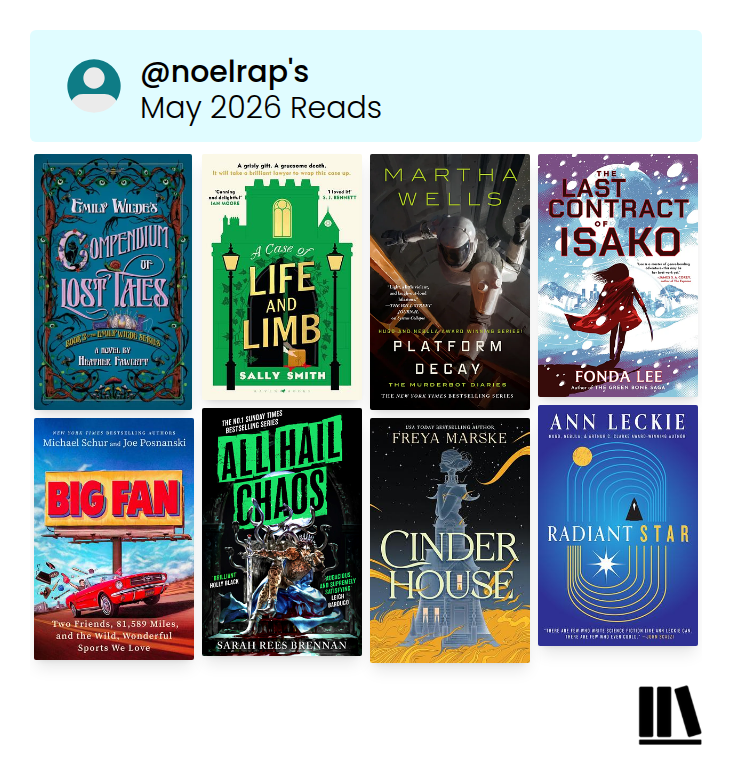
May 2026
Posted on August 9, 2026
This was a big month with all kinds of book releases that I had been waiting a long time for. StoryGraph ratings are as of June 7, I think. I read eight books, and I think we’re going to talk about seven of them.
A Case of Life and Limb — Sally Smith
StoryGraph Rating: 4.19 (6th of 8)
My Rating: Double (6th of 8)
The sequel to A Case of Mice and Murder which I read last month. I like these books a lot. 6th out of 8 this month is nothing to sneeze at.
I really like the main character. Despite being very uncomfortable in social situations, he’s determined not to make others feel uncomfortable. He’s curious, while he can be judgmental, he’s able to take inspiration and learn from those around him. In this case, he’s unwilling to make snap judgments about a 19-year-old actress, and is able to see that she’s smart and brave. He’s a delight.
It’s also a rock-solid mystery story, and a more-than-decent legal drama in the background. Can’t wait for the next book here. This would be a solid BBC series, honestly…
Platform Decay — Martha Wells
StoryGraph Rating: 4.33 (2nd of 8)
My Rating: Triple (2nd of 8)
This is the first Murderbot book since the TV show, (now, the Nebula Award winning TV show) so a couple of notes on that.
- The blurb for this book says “This may well call for… eye contact!”, which is definitely a post-TV thing, because “eye contact” is a bit in the show and not so much in the books. Not even in this book.
- The TV show’s art direction is impeccable, the cast is really great. The decision to actually show Sanctuary Moon worked extremely well. I think they did generally a solid job turning a 150 page novella into 10 30-minute TV episodes. The show’s tone is a little bit broader and more silly than the book, which I think is partly to give the Preservation Humans a little more personality and also because a lot of what the book tells us about them would be hard to get across quickly visually. Like, “space hippies” isn’t exactly what they are, but it’s 300% easier to get across visually than what they actually are.
- Wells seems to think of the show as a very well done AU of the book, and that works for me.
Anyway, this book. It’s billed as “Murderbot has to babysit on a rescue mission”, which is not untrue, just a little overblown. This is about a rescue mission, and when I say that, I mean page one of the book has Murderbot starting infiltration and the last page is Murderbot leaving. There’s no ramp up or down, it’s the no fluff just stuff structure. It’s amazing that Wells can keep that pace up for 250 page (there is a brief flashback to explain the setup). There’s just not really any babysitting.
Murderbot has a new mental health mode, which means it does periodic emotional check-ins, which are pretty funny. But beyond that, it’s Murderbot, getting better at being Murderbot in the world.
I genuinely appreciate Wells’ commitment to not doing fan service in these books. Which is to say, with a fan base that would have been happy to have 250 pages of Murderbot and ART/Peri bantering, or a nice heart-to-heart between Mensah and Murderbot, or even learning more about the crew of Perihelion, we get none of that. It’s all rescue. The entire Preservation/Peri human cast of people we’ve seen before has, I think, exactly one word of dialogue in the book.
It says something about Wells’ skill here that, through Murderbot’s narration, we get the impression of all those other characters and the understanding of how those relationships have changed. The one word of dialog is perfect, as is Murderbot’s description of it. I won’t spoil it for you.
Consistently, through Wells’s career, all books, what she’s great at is creating these enormous, weird, interesting environments with big set pieces, action or otherwise within them. The torus station here is one, the Raksura books have tons of them, the Witch King series has a few, you get the point, she’s amazing at that part.
The Last Contract of Isako — Fonda Lee
StoryGraph Rating: 4.20 (4th of 8)
My Rating: Double (4th of 8)
Marketed As:
“The Last Contract of Isako is epic science fiction like only Fonda Lee can write it”, or, in other words “For fans of Fonda Lee… here’s a book by Fonda Lee.”
Definitely what I needed right now was a book where a 50-something main character is dealing with relations with a new adult child while also dealing with aging in a world where when people are laid off, they are expected to walk out into the wilderness of an alien planet and just die. Real escapist literature, there.
This is a kind of SF that will likely prompt people to say “they don’t write ‘em like that anymore”. it’s not a space opera at all, it’s a look at a kind of dystopian society, but with a real attempt to get us to understand their morality, even if (I suspect) we are not expected to agree. I guess it’s not crazy dissimilar to These Burning Stars.
We’re 500 years into human habitation on a barren, inhospitable world. 25 years in, communications from Earth cut off in what is known as The Great Silence. The planet is basically a company town, the terraforming corporation is the government, and there are no public goods or public government as such.
The title Isako is our viewpoint character, she’s an atier (that’s “a-tier”, took me a minute…), a combination of business advisor and bodyguard, and when we meet her, she’s laying people off. Why, you might ask if you did not read the first paragraph of this note, would you need a highly trained martial artist to do layoffs? Well, because, this is a company town and when you are laid off, you are expected to “resign”, which is to say, walk out of the airlock and into the inhospitable planet, where your life expectancy is measured in seconds. Some people don’t take that very well. Also, this will hit differently if you work at a place that recently did some kind of layoff event.
Isako’s client as we open the book is a Director on the losing side of a corporate war, after his “resignation”, she comes to be hired by the winning side to dig up dirt on yet a third Director, who has extreme pro-terraforming views. (The political split here is between people who want to put 100% into terraforming and people who want to try to figure out what happened to Earth). She quickly learns that the third Director’s atier is missing, and then we get into a nice mix of noir, cyberpunk, samurai, and SF as Isako unravels the mystery.
I rated this a double, it was looking for triple, but I thought the ending didn’t quite work? I don’t completely feel I understand the actions of all the players. (I will note that despite the relatively high SG rating, I did see some reviews that thought it was disappointing, which I guess if you expected Jade City, it’s not that.)
Big Fan – Michael Schur, Joe Posnanski
StoryGraph Rating: 4.35 (1st of 8)
My Rating: Triple (1st of 8)
Probably fair to say up-front that I’m a big fan of both Posnanski and Schur, separately as maybe the best short-form sportswriter going and maybe the best comedy show-runner going, and together as hosts of a truly pointless sports podcast. This book is nominally about what it’s like to be a fan across mostly but not exclusively sports, but it’s also a chance for Joe & Mike to attend cool events, and make the other person attend an event they might hate.
I was a little worried about this only because I’ve been hearing them talk about this for months and months, and I was afraid it’d feel like I read it already. But honestly, they did a great job of hold back most of the cool stuff.
We’ve got largely unconnected essays ranging from Joe writing about a visually impaired NASCAR fan, to a collection of literally millions of baseball cards, to a Buffalo Wild Wings in Dallas on day one of the NFL season. They each let their daughters write a chapter on being a Taylor Swift fan. Good Place writer Megan Amram writes about NYT crosswords.
The book is joyful and sincere and occasionally a little heartbreaking, just like being a fan.
All Hail Chaos by Sarah Rees Brennan
StoryGraph Rating: 4.22 (3rd of 8)
My Rating: Triple (3rd of 8)
So, it’s a little glib to say that this is the book that I wanted Long Live Evil to be, but that LLE was only about 90% that book. It’s worth unpacking why.
Quick blurb — our heroine is a 20-year-old woman named Rachel, who when we meet her, is dying of cancer. She is invited to step into her favorite fantasy series, where she is embodied as a minor villain, and she decides to lean into it. But she makes some very poor decisions…
Last time, I wrote this:
Three quibbles: 1) it takes a while for all the ducks to line up and for the book to get going, 2) Brennan fiddles with the heroine’s specific knowledge of the underlying books in a way that is a little contrived, 3) the book doesn’t end on a cliffhanger exactly, but it does end on a major revelation.
To quickly mention 2 — I still think it’s convenient that Rae somehow is missing a major fact about a major character (that character’s original name), but looking back, there are multiple clues in book one that she is acting on incorrect information.
1 and 3 are related, this series has an odd structure for a trilogy. Your classic trilogy has book one end on a moment of local triumph with the larger battle still to come. Book two expands the world, describes the larger conflict, and often ends on a cliffhanger or a moment of despair. Book three resolves everything.
There’s never really a moment of local triumph for Rae, most of book one is about getting to the big reveal at the end, which means it is actually laying down a lot of exposition. With that all done, book two is free to be somewhat wilder. This book is funnier, sharper, and more chaotic than the first one.
By the end of the book we have a SPOILER number of people from our world running around trying to fix the story, and all of them make a total hash of it. It’s rare to see a book where the side we are nominally rooting for makes so very many bad decisions, and even rarer to for that book to have those decisions mostly make sense and not make the reader irritated.
There’s a lot going on, we have to track not only the actual story, but multiple iterations of the story that existed before Rae jumps in. And our knowledge of that previous history makes some of the beats of this story hit harder. It’s a very hard tone to pull off, given the amount of potential exposition, and yet it all mostly works.
There’s also a lot the book says about relationships with favorite characters, especially favorite evil characters, and what those kinds of stories are for, and what it’d be like to meet your villainous hero.
There’s a reveal in this book I did not see coming, and another one I should have seen coming, and if you thought the last one ended on a cliffhanger…
Kill Your Darlings has a title but not a date.
Cinder House — Freya Marske
StoryGraph Rating: 4.04 (8th of 8)
My Rating: Double (7th of 8)
2026 Hugo Award nominee for best novella.
This is a Fairy Tale Retelling, ™ and patent pending. You may have guessed which one from the title.
The catch here is that Ella dies on basically page one, and becomes a ghost bound to the house her stepmother and stepsisters now own. The wicked steps soon learn they can command Ella to do any sort of house tidying, and they can compel her to do pretty much anything else once they learn that any damage to the house causes Ella pain.
There is, of course, a prince. He is charming, or at least charmed, such that anybody who watches him dance falls in love with him instantly. There is a festival, and midnight, and magic shoes.
I liked this — at it’s worst, it feels a little by the numbers, but at its best, it does a nice job of making the sympathetic characters sympathetic and making the familiar story beats feel motivated. (I also thought the magic was nicely done).
Radiant Star — Ann Leckie
StoryGraph Rating: 4.20 (5th of 8)
My Rating: Double (5th of 8)
First sentence:
“In the city of Ooioiaa, there are of course several different consororities, but when one says “the Consorority” one means the Consorority of the Translocation” — it’s the “of course” that gets me here. If you showed me this sentence blind, only telling me it was published in 2026, I feel quite confident I would have guessed the author was Ann Leckie in fewer than three guesses.
We are, as mentioned, in Ooioiaa, the only city on the planet of Aaa. This book is part of Leckie’s Radch series, with the events of other books kind of hinted at in the background. But our focus here is on Ooioiaa (I really feel for the audiobook narrator…), recently conquered by the Radchaai, and where there is a huge religious focus on the Temporal Location of the Radiant Star and the various sects, saints, and savants thereof.
I have to admit, I make fun of marketing blurbs here, but this one is honestly stellar, it succinctly describes the actual plot of what is kind of a sprawling book and doesn’t pretend the book is something it’s not.
What the blurb doesn’t tell us is how completely weird this book is, as, I supposed, evidenced by the first sentence. This is SF in the Jack Vance mode, presenting a culture whose motivations seem utterly bizarre to us, but from a narrative voice that takes that culture for granted. The narrator is pretty voicey and clearly expects the reader to have in-universe knowledge of at least some of the religious doctrines in play. Leckie wisely does not really explain why the Radiant Star is a point of worship, it’s enough that we accept that it is. (Leckie also said on social media that the narrator’s identity isn’t meant to be a puzzle to figure out, also the correct decision.)
What the book is actually about is a little hard to describe? You ever see the demonstration of a chain reaction involving mousetraps and ping-pong balls? This book spends the first 200 pages or so setting up mousetraps — we have some sectarian conflict over the temple, there’s conflict over a rich person attempting to purchase sainthood, there’s a colonization conflict with the Radchaai overlords, there’s the Radch civil war happening deep in the background, and a couple more besides. And then the ping-pong ball drops, and there’s glorious chaos for about 75 pages, and then there’s an ending.
At its best (that chaotic 75 pages) the book is amazing, I did come to actually care about the stakes, which are mostly the management of this temple. (There are some stakes about whether the whole planet will fail, but it seemed pretty clear that part would resolve itself). The stakes are so small — like the book is not exactly cozy (it only scores about a 3 on my patented cozy metric), but it’s also not epic, exactly. The ending, I thought, was a little anticlimactic, but that’s kind of a minor point against the fabulous buildup.