Video

A journey through attempting to get an LLM to improve the quality of Ruby code by asking it what famous Rubyists might do.
Inspector Gadget: Adventures in Agent Review
Chicago Ruby Meetup · 2026


Ruby rewards thinking about types with a dynamic mindset instead of a static one. In this workshop, we'll show how use Ruby's dynamism to your advantage.
The Dynamic Ruby Toolkit
SF Ruby · 2025

I didn't give a talk here, but they let me introduce the lightning talks, which was fun, here's my brief introduction.
Lightning Talks Intro
RailsConf · 2025

(This video is only the screen, not on me). It's A nostalgic and insightful journey into what makes Ruby uniquely expressive and joyful, by exploring Ruby's most Ruby-ish features.
Does Ruby Love Me Back
Chicago Ruby Meetup · 2025

New Ruby developers often wonder how to write safe code in Ruby without static typing. In this workshop, we’re going to refactor working code to get the data validation and safety of static typing, but using Ruby’s existing features.
Workshop: No Static Types? No Problem!
RubyConf · 2024

A look at new Ruby features in Ruby 3.x versions, with a discussion of which ones have caught on and why.
Ruby's Legacy and Ruby's Future
SF Bay Area Meetup · 2024

Rails is powerful, but it doesn't do everything. Sometimes you want to build your own tool that adds functionality to Rails. If it's something that might be useful for other people, you can write a Ruby Gem and distribute it. In this workshop, we will go through the entire process of creating a gem, starting with `bundle gem` and ending with how to publish it with `gem push`.
Workshop: Let's Extend Rails with A Gem
RailsConf · 2024

Ruby puts the Ruby in “Ruby on Rails”! It’s the Ruby language that makes Rails flexible, powerful, and with a developer-friendly API. How does Rails take advantage of Ruby’s flexibility and metaprogramming to make it so useful? And how can you take advantage of those features in your Rails app?
Rails on Ruby: How Ruby Makes Rails Great
RailsConf · 2023

If you’ve learned Ruby recently, you’ve likely been told to avoid using Ruby’s metaprogramming features because they are “dangerous”. Here at RubyConf, we laugh at danger. Or at least chuckle nervously at it. Ruby’s flexibility is one of the features that makes Ruby powerful, and ignoring it limits what you can do with the language. Plus, metaprogramming is fun.
In Defense of Ruby Metaprogramming
RubyConf · 2022


Mentorship is a great way for a newer developer to benefit from the experience of a more senior developer. While there are lots of available resources on how to be a good mentor or mentee, there are far fewer guidelines on how to set up a mentoring program within your engineering organization.
Building a Mentorship Program
RailsConf · 2020

As developers, our work is mediated through many tools besides languages. We use terminals, browsers, git, and the os. Not to mention editors. These are powerful tools that can be infinitely customized and extended. The tools can make common tasks easier or less error prone to perform. Or they can give you visibility into system behavior.
The Developer's Toolkit
RubyConf · 2018


Having a structure where developers feel supported makes them happier, and less likely to leave. How can you manage reviews and goal structures to benefit your team.
The Goal of Having Goals
Madison Ruby (Chicago) · 2018

There is a value in writing tests and there is also a cost. The currency is time. The trade-offs are difficult to evaluate because the cost and value are often seen by different people. The writer of the test bears much of the short term cost while long term benefits and cost are borne by the rest of the team. By planning around both the the cost and value of your tests, you’ll improve your tests and your code.
High Cost Tests and High Value Tests
RubyConf · 2017

Legacy code. We’ve all dealt with it, we’ve all screamed at it. And we’ve all written it. A project becomes legacy when developers no longer have the context of old decisions. The transition to legacy status happens step by step, decision by decision.
The Road To Legacy Is Paved With Good Intentions
WindyCityRails · 2017

Test doubles (which you may know under the alias “mock objects”) are the most misunderstood and misused testing tools we've got. Starting with the fact that nobody can agree on what to call them. Contrary to what you may have heard, test doubles do not inherently lead to fragile tests.
Test Doubles Are Not To Be Mocked
RubyConf · 2016
Your customers have money, and you’d like them to give it to you. Payment gateways, such as Stripe, Braintree, and Paypal, make it easy to start charging credit cards and get the money flowing. But charging cards is only the beginning. Learn from some of my mistakes and build a robust financial application.
Money Makes Your App Go Round
WindyCityRails · 2016

Noel Rappin shares his experience running HR for a year as a developer, offering insights and answering questions about the intersection of technology and human resources.
I Was A Developer Running HR For A Year: AMA
Madison Ruby Epilogue · 2016

Estimates are like weather forecasts. Getting them right is hard, and everybody complains when you are wrong. Estimating projects is often critically important to the people who pay us to develop software. We can do better.
This Talk is 20 Minutes Long (Give or Take 10)
RubyConf · 2015

Beyond Red/Green/Refactor: Testing as a Mindset
WindyCityRails · 2015


"Red. Green. Refactor" is a great slogan for Test-Driven Development. It's less great as a guide to actual TDD practice. The slogan provides no guidance for two very important questions in a TDD process: "What do I test next?" and "How do I break my problem into testable pieces".
What We Talk About When We Talk About Testing (Ruby Remote Conf Version)
Ruby Remote Conf · 2015

RSpec is often described with the word “magic” by both its users and its detractors. Understanding how RSpec matchers, doubles, and specifications work will help you as an RSpec user. You will be able to take advantage of RSpec’s flexibility to make your tests clearer and more expressive. You’ll also get some exposure to new RSpec features, like compound matchers.
RSpec: It's Not Actually Magic
RailsConf · 2015

Estimates are like weather forecasts. Getting them right is hard, and everybody complains when you are wrong. Estimating projects is often critically important to the people who pay us to develop software. We can do better.
Estimation and Trust-Driven Development
Ancient City Ruby · 2015

What we talk about when we talk about testing
Geekfest · 2015
Trust-Driven Development: Maintaining Trust in Crisis
Geekfest · 2014

This is a panel discussion featuring Ben Orenstein, Bree Thomas, Jeff Casimir, Jen Meyers, Kathryn Exline, and Liz Abinante about how best to bring new developers into the field, and what kind of knowledge they will need to be successful. What can we, as a community, do to improve our management of new developers? What can new developers do to give themselves the best chance of success?
Panel: Teaching the Next Great Developers
RailsConf · 2014

Smalltalk has mystique. We talk about it more than we use it. It seems like it should be so similar to Ruby. It has similar Object-Oriented structures, it even has blocks. But everything is so slightly different, from the programming environment, to the 1-based arrays, to the simple syntax. Using Smalltalk will make you look at familiar constructs with new eyes. We'll show you how to get started on Smalltalk, and walk through some sample code. Live coding may be involved. You'll never look at objects the same way again.
But Really, You Should Learn Smalltalk
MountainWest RubyConf · 2014
Rails vs. Object Oriented Programming
WindyCityRails · 2013
Technical Writing For Fun and... well, For Fun
Geekfest · 2013

Two completely different ways have emerged for using Rails as the back end to a rich client-side JavaScript application. We will look at code to see the structural difference between these two approaches and see what the speed, extensibility, and maintainability trade-offs are.
Rails vs. The Client Side
Rails Conf · 2013


I don't think I'm alone in being drawn to TDD at first because it was fun. The quick and consistent feedback and the ability to turn complicated problems into a series of smaller problems to be solved made TDD development seem more like a game than work.
Testing Should Be Fun
RubyConf · 2012
Let’s Make Testing Fun Again
WindyCityRails · 2012

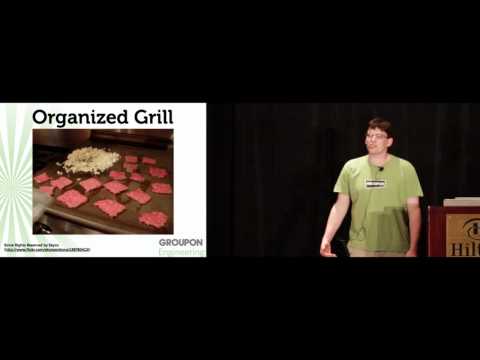
Five minute lightning talk about setting up your developer mis-en-place.
Manage Your Development Environment and Never Burn another Burger
IgniteRails · 2012

Everybody wants to do test-driven development, but switching to TDD or BDD on an existing project that doesn't have tests presents special challenges. Often, the current code is a tangled mess of dependencies that defeats the very concept of unit testing. Worse, if somebody has attempted TDD in the past, you might have a test suite that needs to be fixed before any new tests can be written.
Test Your Legacy Rails Code
Ruby Midwest · 2011
You, yes you, could write a technical book about a subject that you are interested in and want to excite others about. But how should you pick a topic? How can you stay excited as you write the book? How should you distribute the book?
If They Asked You, You Could Write a Book
Ignite Rails · 2011
You Got Your Agile in my UXD
Refresh Chicago · 2010

Testing Done Good
Chicago Ruby · 2010
How To Test Absolutely Anything
WindyCityRails · 2009