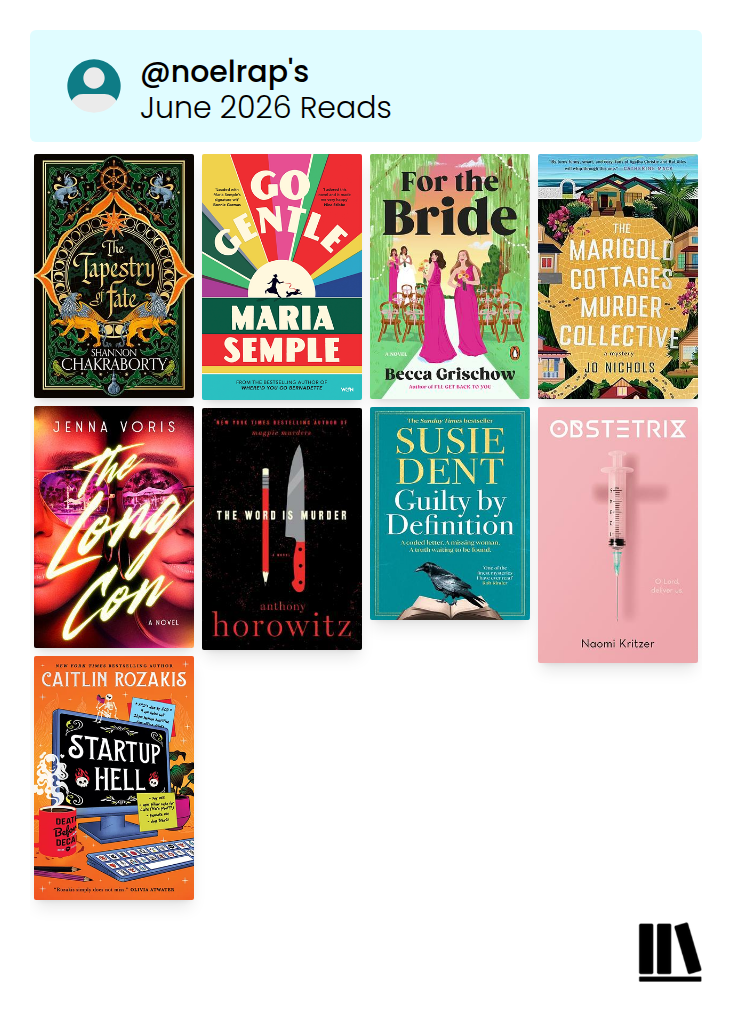
June 2026
Posted on September 5, 2026
I read nine books this month, and honestly not as many high notes as last month. I think we’ll talk about eight of them.
The Tapestry of Fate — Shannon Chakraborty
StoryGraph Rating: 4.47 (1st of 9)
My Rating: Double (1 of 9)
Book Two of the Amina al-Sirafi Adventures
To start with the positives: this book still has a lot of what made the first book great. Amina is a great character, the use of folklore and myth from the Persian Gulf region is very interesting. Chakraborty does a good job of weaving the mythological magic in with the story and still having the action and motivations be manageable.
This book picks up a little bit after the end of the last book, with Amina getting a new assignment from her new supernatural frenemies. She needs to recover a magical spindle. Easy! Except it’s in the possession of a magical queen on a mysterious island who has the power to rewrite fate and change people into sheep. Less Easy!
Our Heroes set off (after a detour that serves to set up Amina’s daughter as a character), and they are eventually shipwrecked on the mysterious island, Amina is separated from all but one of her crew, and then the plot proper kicks in.
It is certainly a choice to have a book series about a notorious pirate and her crew and then have the bulk of the last two-thirds of the book take place on land, with the captain separated from the crew. And yet it works, mostly. “It’s a little too long” is a very annoying comment about a book or movie because “too long” is usually the symptom and not the cause. In this case, the book does basically the same scene — Amina investigates something mysterious, has health problems, mistrusts her best friend — a few more times than strictly necessary.
The last two words of the book lead us to… well, I have my suspicions, but we’ll see.
Go Gentle — Maria Semple
StoryGraph Rating: 3.62 (8th of 9)
My Rating: Single (7 of 9)
Marketed As:
Well, it’s an Oprah book, so it’s got a quote from Oprah that it is both a “page-turner” and “one wild ride”. So it’s got that going for it.
This book has very strong “Apple TV 8 episode series” energy — it’s kind of a mystery but not really, it’s kind of a romance but not really, it’s breezy and funny, but not a pure joke. In a way I can’t quite define, but feel in my heart, it’s the harmonic mean of Lessons in Chemistry and Margo’s Got Money Problems, both turned into Apple TV shows, even though it’s really not that much like either of them.
Our hero is Adora, she’s made her mark as the author of a popular translation of Stoic Philosophy and she’s got a cushy job as the in-house philosopher for a wealthy NYC family that has their own museum. One day she has a meet-cute with Digby, who has a mysterious job and gives her a mysterious mission. From there she gets caught up in what may be a plot involving guns being smuggled as art, or possibly art being smuggled as guns, or maybe art being smuggled as art.
But it’s not really that much about the plot. Adora has a past, and the book has a lot of questions about whether Stoicism is actually helping her or just helping her avoid her life.
It’s the kind of book where there’s a news item in the first chapter that activists have blown up the Rosetta Stone, and you are, for some time, not quite sure if we are meant to take that as satire, or as a sincere thriller plot beat, or perhaps both. And if you say “that’s not a kind of book”… exactly, the book is weird (complimentary). And its particular genre mix feels more like a TV show than a book, which brings us back to 8-episode Apple TV series.
I pulled this quote from an interview with Semple — “one of my beliefs is that your protagonists can’t have friends.” Because a friend would talk the protagonist out of doing the crazy thing you need to drive the plot. Honestly, I’ve heard worse writing advice.
The Marigold Cottages Murder Collective — Jo Nichols
StoryGraph Rating: 3.84 (3rd of 9)
My Rating: Single (8 of 9)
Marketed As:
“in the vein of The Thursday Murder Club or Only Murders in the Building but with a southern California twist.” That gives you “amateurs bond while solving a murder” and “a murder happens in their place of residence” and “we are in California”. I mean, that’s about it, except this book has non-elderly detectives.
This book very much tries to do what Osman does in Thursday Murder Club, by which I mean a murder mystery with multiple viewpoints from a group of people who become a tighter community through solving the murder. In this case, it’s a group of people who live in the title cottages, a group of small bungalows in Santa Barbara owned by Mrs. B, an elderly eccentric who likes to take in strays.
Anthony, a menacing-looking ex-con, moves in, and shortly thereafter a real estate developer is found murdered in the courtyard. The police put one and one together and arrest Anthony. Mrs. B., insisting on his innocence, marshals the other tenants to prove his innocence, and off we go. (I will note that the blurb tells us that Mrs. B. confesses, which is true, but that’s on like page 200, which I think is well past the event horizon at which you put plot points in marketing blurbs)…
For most of the book my thought was, this does an OK job of doing what Thursday Murder Club does really, really well. It’s a little too insistent on showing us how quirky the characters are, and a little too blatant in showing us how they are fixing each other. But it’s fine, enjoyable, the characters are easy to hang out with.
The ending… Well, look, I’ve seen murder mysteries where the detective effectively does unilateral jury nullification. But, well, in this one…
— MASSIVE SPOILERS AHEAD REALLY DON’T READ THIS — (actually, wait, I’ve given myself spoiler text as a display option, let’s use that…) It turns out that Mrs. B. is actually guilty of the murder and a second murder is actually done by Anthony, to protect Mrs. B. And the other tenants, who were worried that, Anthony might have violent impulse control problems, upon learning that he actually does have a violent impulse control problem, decide en-masse to frame a tenant’s ex-husband (who admittedly did try to kill that tenant). That does not count two other felony assaults that we overlook because the good guys did it to punish a bad guy. And look, I like Batman as much as anybody, but in the real world, this is genuinely bad, right?
For The Bride — Becca Grischow
StoryGraph Rating: 4.10 (2nd of 9)
My Rating: Single (6 of 9)
Sometimes my rating scale just doesn’t really fit. This is a very enjoyable book, that breaks no new ground, but which has more depth in it than it needs to get by. The official line for double is “would I recommend this to myself if I had a lot less time to read”, and the answer is “probably not, but maybe” That said, I did enjoy it a bunch. (I also think the SG rating here is an exhibit in the “romance fans give higher ratings than mystery fans” theory.)
Our two FMCs are Alice and Renee, Alice is our viewpoint. They are brought together as bridesmaids for a mutual friend, but they loathe each other over past slights. This is enemies to lovers of the flavor “the people they hated are in the past, the new people are much better people”. Alice is trying to put her life back together with relatively new sobriety and quite recent grief over her father’s death.
This has most of what I look for in a romance novel — I believe the characters are good for each other, there’s a background plot that they need to work together one, there are some time honored tropes (Only! One! Bed!), but Alice’s complex grief and attempt to make amends for her real past mistakes gives the book enough of a background that makes it really work.
The Word Is Murder – Anthony Horowitz
StoryGraph Rating: 3.79 (5th of 9)
My Rating: Single (4 of 9)
This one is weird because my “Marketed As” section is about how another book referenced this one — This book was one of the comps in the Everyone in My Family Has Killed Someone series. It’s also metafictional, but less satirical. In this case, Horowitz, a UK novelist and TV mystery writer of some renown, finds himself acting as the Watson to a Detective Hawthorne, a former cop turned consultant. Unlike the Ernest Cunningham books by Benjamin Stephenson, Horowitz doesn’t do any goofing off about the rules of mysteries. He does do metafictional goofing on the difference between the story as it happened, and what he does to shape it into a novel, he argues with Hawthorne about it rather a lot.
The setup here is that Hawthorne approaches Horowitz to write a true-crime book following his adventures, baiting him with the details of an unusual murder. Horowitz agrees, for reasons, even though he doesn’t like Hawthorne. From there, we get… well, we get a murder mystery, peppered with some commentary on what makes a mystery story interesting. The mystery is well-done, the commentary is solid, if a little precious at points, and the way that Horowitz is willing to pull this into his actual real life is interesting. (Though, as a mystery, it’s something of an exercise into how red you can make a red herring and still have chasing it feel relevant to the plot.)
The thing about Sherlock Holmes as an archtype is that he’s not actually supposed to be an asshole, he’s just working on a different plane of existence than everybody else. (This is one reason why Elementary is a better take on Holmes than BBC Sherlock, even though there are some individual amazing episodes of Sherlock). Horowitz really leans into it here – Hawthorne goes past just being unusual into actively being unlikable. (Horowitz makes him really homophobic to the point where I thought it was meant to be a bit.) Horowitz doesn’t make himself particularly likable either, which makes for a weird backdrop if both the characters are kind of annoying.
And yet, I checked out book two, in part because I am an easy sell on metafiction, and in part because I’m curious if or how Horowitz modifies the characters over time.
Guilty By Definition – Susie Dent
StoryGraph Rating: 3.82 (4th of 9)
My Rating: Double (2 of 9)
Marketed As:
Well, it has a blurbed quote from The Washington Post that ends “the perfect tonic for any philobiblist’s mubble-fubbles”. Yes those are both words (bibliophile and a state of depression, respectively). They are both defined in the book itself, FWIW. And no, my spellcheck doesn’t recognize either of them.
So, our main characters here are a group of editors at what is Legally Not the Oxford English Dictionary, it’s just a very prestigious dictionary that happens to be at Oxford. One fine day they get a very cryptic letter in the mail signed by “Chorus”, as several of them separately get postcards with ominous Shakespeare quotes and such. It quickly becomes clear that the letters are all to do with the 15-year-old mysterious disappearance of Charlie, the older sister of one of the editors.
Martha, the younger sister, goes to the police, and is encouraged to ask around about Charlie to see if she can learn anything new. And it turns out a lot of people have secrets, some of which relate to the disappearance, some of which don’t. The letters keep coming, though.
Your general enjoyment level here is going to depend on how much you like characters with very large vocabularies and who love language, and on how much you like reading about people solving cryptic crosswords. The general rhythm of the book is, they get a letter, it’s hiding a message, they use that message to talk to somebody to get more information and so on. It also helps if you are up for a lot of descriptions of how Oxford is a special place (this would make a very odd double feature with Babel…)
I’m fine with all that, and I basically enjoyed this one — amateurs solving mysteries with their specific skills seems to be one of my sweet spots. A couple of spoiler-y quibbles with the ending — there’s a point in the middle of the book where it becomes clear what’s actually happening and it becomes clear who had the most at stake in what Charlie was doing before she disappeared. There are some logistics that are surprises, but overall, I feel like if I guess this much of the finale, then the mystery is pretty easy. We do learn who “Chorus” is, which isn’t really played as a mystery to be solved, and the book does explain why that person sent the letters, though not really why the letters needed to be super difficult cryptic crosswords.
Obstetrix — Naomi Kritzer
StoryGraph Rating: 3.77 (6th of 9)
My Rating: Double (3 of 9)
Marketed As:
The blurb starts with “Doctor Liz has just been acquitted for performing the last abortion in North Dakota when she’s kidnapped”, and that’s a weird sentence. First of all, “Doctor Liz”? Second of all, that’s not quite the way the book phrases it. It’s not inconsistent, it’s just kind of oversimplified.
There’s a genre issue here, this is a little bit being marketed as SF because it takes place in the future, but the only actual difference from 2026 reality was a very thin difference in the law, I don’t think there’s any substantive tech difference (maybe a very very slight one), it’s really a “15 minutes in the future” thriller, but in a more minor key.
Our main character, Dr. Liz Gwinn (I have to imagine that it kind of bugs Kritzer that the marketing copy drops her last name), is, as we meet her, still recovering from having been prosecuted for normal medical care that is now illegal in North Dakota. She follows a potential job lead, and for her troubles she is drugged, kidnapped, and taken to what can only be called a cult compound to act as their resident OB/GYN for the many, many pregnant women on site.
The rest of the story is survival in the sense of gathering resources and looking for your chance, survival in the sense of maintaining sanity, and (a little bit) survival in the sense of building community. It’s genuinely disturbing in a “boy I wouldn’t want to be stuck on a cult compound” kind of way. Even though Liz is rarely in direct physical danger, that risk and the attempt to control her actions and thoughts loom over the entire book.
The execution here is very strong, there’s a nice running bit about the stories that Liz uses to ground herself and remember the outside world (and a creepy bit at the end where she realizes that she’s unconsciously changed her vocal register after being at the compound).
It’s not often I think a book should be longer, but this book spends a few pages at the very end explaining what’s been happening while Liz was captive, and I think I would have been happy to have that as an interlude every couple of chapters. I think you could still keep the suspense and the sense of frustration going on the other side as well. (To be clear, I understand why Kritzer chose to keep a tight focus on Liz, I’m just saying this other choice would have also worked.)
Startup Hell – Caitlin Rozakis
StoryGraph Rating: 3.77 (7th of 9)
My Rating: Single (5 of 9)
Marketed As:
Look, here’s the whole text: “A hilarious contemporary fantasy about a junior sales witch stuck in corporate hell, who has to evade devilish pacts and her kickass, world-saving, demon-slaying mum to save a (surprisingly hot) demon, and work out how to hit her quarterly target”. My only quibble here is that she’s not a “sales witch” – the fact that she isn’t a witch is the whole point of her character. The rest is fine, if maybe tonally slightly different from the actual book. It remains weird to me that there is a term “urban fantasy” and yet a book that involves demons that takes place in New York City doesn’t count.
This book went a little harder than I expected. Honestly, I was expecting what you might call the romcom version of a startup job, which is to say, not exactly realistic, just some vibes and some hooks to hang a plot on. (For some reason, I’m thinking of The Hating Game…). Rozakis, per her author note, has 15 years of experience in marketing at startups, and has clearly Seen Some Stuff, which gives the book more of an edge than I thought it’d have. There’s a particular bit about venture capital and vampires, that isn’t maybe a 100% original thought, but it was well-executed, and eventually Morgan’s growing ethical dilemma about working in this particular startup feels very honed from the ethical dilemma of working at a lot of startups.