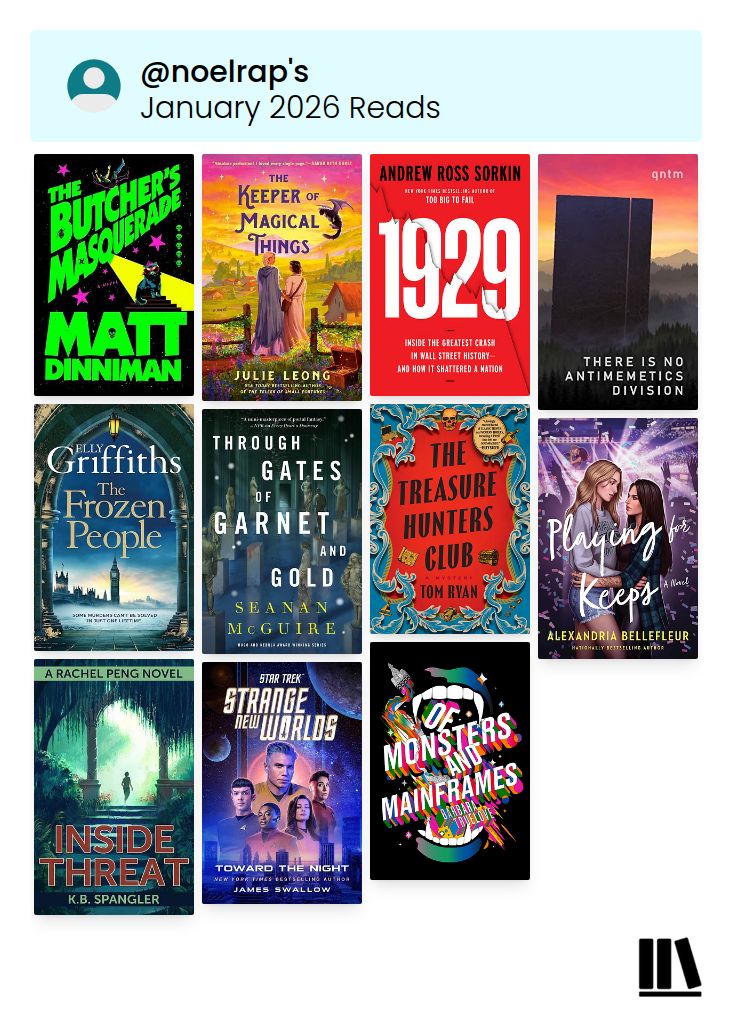
January 2026 Books of the Month
Posted on May 31, 2026
Listen · 15:11I’ve been doing book review posts here for a pretty long time, and I love doing them, but they are somewhat time intensive. I finally remembered the XP approach to work intensive practices, which is to do the job more frequently, in smaller bursts. I’ve been doing that – I’ve been writing reviews of books as I go, but editing my initial rambling into this rambling is what takes most of the time.
So we’re going to try posting month-by-month. We’ll start catching up with January 2026. (Secretly, I’m hoping this will get me to write more in general, don’t tell anybody.)
Ground rules:
- I’m not writing about everything I read. I’m not interested in writing publicly about books I didn’t like, and sometimes I just don’t have anything to say, even about books I like.
- That said, this should end up with me writing about more books overall.
- There will still be a year-end post, but it’ll likely be shorter. But who knows.
- Books are listed in the order I read them, because that’s the order my drafts are in.
- I’m giving my score, using the baseball system from The 2025 Book Post, and the StoryGraph score as of May 31, 2026. And I force ranked mine, to match the StoryGraph scores.
I read 11 books in January, and I’m writing about 8 of them. Here goes..
The Butcher’s Masquerade – Matt Dinniman
Book 5 of Dungeon Crawler Carl
StoryGraph Score 4.58 (1st of 11 this month)
My score: Double (3rd of 11 this month)
I put this in the 2025 recap, but it only took 5 books for me to realize that DCC has roughly the same energy as Battlefield Earth:
- Earth has been conquered by much more powerful aliens
- Some random dude decides to destroy them starting from nothing with just pluck, luck, and leverage.
Anyway, book 5. I appreciate that Dinniman is to some extent taking the consequences of this premise seriously, mostly just how messed up the galaxy needs to be for the dungeon crawl to even exist. The books are getting somewhat lore-heavy, there are a few times here where there’s a callback to an earlier book that isn’t fully explained, I expect that eventually I’ll need to read this with a fan wiki at hand or something.
The book is still pretty tense, for as long as it is, Dinneman does a good job of keeping the stakes clear, he is starting to go the “here’s the plan, fade to black” a little much especially for a series in first-person narration. Still, though, you can see Dinniman get better and better as the series moves on.
The Keeper of Magical Things — Julie Leong
StoryGraph: 4.24 (3rd of 11)
Me: Double: (1st of 11)
First line:
Certainty Bulrush was in the midst of arguing with a particularly intractable quilt.
Our POV character, Certainty, is a Novice Mage with the ability to talk to objects. Well, I guess anybody can talk to objects. But they talk back to Certainty. Her other magical skills are somewhat lacking, so she is stuck with no clear path to becoming a full Mage. Through one thing and another, she finds herself assigned to the least magical town in the realm helping to create a storehouse of magical junk that the Mages need to store someplace safe. She’s accompanied by Aurelia, a Mage with a reputation as an ice queen who has some secrets of her own.
You mostly know where this book is going, though the journey is fun. Will they find the perfect artifacts to wake up the sleepy and depressing little town? Will they fall for each other? No spoilers wink. But it’s all really charming, the interactions with the objects are well-done, it’s got a certain kind of “let’s put on a show”-adjacent energy, and I liked the ending lots.
That’s two really solid books for Leong, who is good candidate for my informal “authors whose next decade of books is exciting” list.
This book made me want to talk about genre, though admittedly almost every book makes me want to talk about genre. Wait, I have a section header…
Marketed As:
The marketing blurb for this book calls it a “charming novel” and does not use the words “romance” or “fantasy” or “cozy”. Granted that it does say that there’s magic, so “fantasy” is probably implied. What is it, though?
Romance has an actual official definition, at least according to the Romance Writers of America, who I guess would know: “Two basic elements comprise every romance novel: a central love story and an emotionally satisfying and optimistic ending.”
Whether this book is a romance by that definition depends on how you define “central” — the romance plot and the plot-plot are very close to 50/50 in this book. Normally I’d look to which plot drives the ending that the writer wants you to see as the true victory, but actually both plots resolve at the same time with the same action (which is nicely done, honestly).
It is obviously a fantasy — we’ve got magic and everything. I guess technically you could call it a romantasy, but if you are looking for deeply angsty enemy to lover action, this is not the droid you are looking for, so to speak. And it’s interesting that the publisher is not marketing it as romantasy.
It does score a 7 or 8 on the cozy scale, so I guess what this really is is cozy fantasy.
This has grown on me over time, and I think it’s clearly my favorite book of January. A lot of is fun, it’s maybe a hair two long in act 3. Honestly, I think I would have liked the romance plot to be a little more centered. Aurelia’s necklace is an interesting character/plot bit in a “fantasy lets you make a metaphor concrete” kind of way.
1929 by Andrew Ross Sorkin
StoryGraph: 3.95 (7th of 11)
Me: Single (7th of 11)
Marketed As:
I wish non-fiction books had marketing blurbs that said things like “for fans of House of Morgan and the Money Stuff newsletter.
A couple of semi-random notes about a book that I did learn a lot from…
-
Pacing narrative non-fiction is hard. This book has two problems. The first, which is kind of endemic to the genre is a problem with interrupting the flow. The narrative will have a line like “With steely resolve, John Doe walked into the room.”, followed by “Born in 1880, Doe came from a long line of…” And then we get two pages of John Doe backstory that brings the narrative to a screeching halt. But the alternative is not giving the reader the full weight of what it means that John Doe walked into the room, it’s a hard problem.
-
The second is more specific to this book. It’s very vignette based, and at the end of the day, I feel like I kind of missed a sense of the overall sweep of what happened while we got kind of caught up in the tangles of a handful of bankers. It starts way early, though, which does put the October 1929 crash in context really well.
-
Seriously, though how do you do this book, title the chapters by date and not have a chapter titled October 29, 1929.
-
It is neat, though, that a lot of the people involved are legendary names that are still companies to this day. Merrill, Lynch, Morgan, Fox. Even David Sarnoff pops in.
-
“Gambling on stocks had replaced drinking as a legal intoxicant”
-
Maybe the wildest thing I learned in this book. Public issue poling wasn’t really a thing in 1932. But to the extent that it was, Hoover lost to FDR, not over the economy — voters largely saw a kind-of recovery in 1932, and may have been skeptical of FDR’s plans — but over prohibition, which Hoover supported and FDR vowed to end. Wild.
There is no Antimemetics Division by qntm
StoryGraph: 4.06 (6th of 11)
Me: Single (5th of 11) (but it was a close call, almost a double. I might change my mind.)
Do the Math:
(The Rook + The Laundry Files) / 2 with the darkness turned up some
Marketed as:
“a whip-smart tale of science-fiction horror”, which isn’t bad, the blurb ends with “Welcome to the Antimemetics Division. No, this is not your first day.”, which is frankly, outstanding.
The setup here is that we are following the Unknowables Organization, and specifically the Antimemetics division. An anti-meme is an idea that steals memories. Of course, one problem with a division studying anti-memes is that everybody tends to forget what they are working on.
The first like 60% of this book is a mix of vignettes and reports about various anti-memetic objects, with clearly some story going on in the background. At about the 60% mark, everything blows up, and we spend the rest of the book resolving the plot. (Worth noting that this all started on the SCP Foundation website, which is collaborative fiction about… well, any description I give will be inadequate.)
The first half of the book is more successful, it’s weird but manageable and the memory games are comprehensible — it’s a lot like a darker version of The Rook series. I like the format switches.
The second part… well, I think there’s a point at which when you state that you are describing ideas beyond human conception, it’s pretty hard to describe them in such a way that is within human conception, so there’s a lot here that you kind of have to take on faith. (To some extent this is true of a lot of SF/F, but there’s a point beyond which it’s hard to sustain. The thing about Case Nightmare Green in the Laundry series is that Stross is pretty careful to make his eldritch nightmares have to fit in a human brain – he’s also pretty clear that Case Nightmare Green is unavoidable and undefeatable).
On the whole, I did like this, but I’m not sure it’s for everybody. The people who it is for, though, are going to love it.
The Treasure Hunters Club — Tom Ryan
StoryGraph: 3.68 (11th of 11)
Me: Double (4th of 11)
Marketed As:
Per the blurb: “Everyone in My Family Has Killed Someone meets The Goonies”. That’s fair. I take this to mean “somewhat low stakes mystery with twists and something like a treasure plot”. It’s got a little bit of Westing Game DNA too.
So this is a weird one because it got a lot of good reviews and it was an Edgar award nominee… But it’s StoryGraph score is lower than you’d expect given that. This is the biggest gap between SG rank and my rank this month. My guess is two things: 1) as an award nominee, the book was read by people outside it’s natural audience, and 2) I think twist-based mysteries are inherently divisive.
Wait, rabbit hole. It was nominated for the “Lillian Jackson Braun Memorial award” which is given to a “contemporary cozy mystery”, which you know I couldn’t help trying to figure out. The website lists 10 criteria. The main points are:
- contemporary
- amateur detective with no training
- emphasis on being part of a community
- sex and violence are off page
- it’s “light in tone, often humorous”
Sounds like my thing, actually, so I’ll be looking out for more of those.
Anyway, the main characters here are three people who wind up in a small coastal town in Nova Scotia for different reasons. A fifteen-year old girl who grew up there, a struggling author who is house-sitting, and the long-lost grandson of the richest family in town. They all get caught up in a local mystery — buried pirate treasure, never found. And then there are a few mysterious deaths, and well… we’ve got a novel.
I mostly liked this, the vibes are good and it carries itself through what might otherwise be a kind of a slow burn setup pretty well.
- There’s a big, big twist at about the 75% mark. It’s maybe right on the edge of fair play, and I suspect it turned off a lot of people.
- Amazon reviews call it “choppy”, which might be code for “the three stories don’t intertwine the way we want.” But the pacing of the end is genuinely weird — it’s tense for about 5 seconds and then it’s over.
- There’s also a trope at the very very end that I genuinely dislike, but it’d be a spoiler to say that [REDACTED] does something unilateral with [REDACTED], that is the kind of thing that only happens in books.
Inside Threat — K. B. Spangler
StoryGraph 4.32 (2nd of 11)
Me: Single (6th of 11)
Book six in the Rachel Peng series, which is itself a small part of the extended story called A Girl and Her Fed. The Peng books are relatively straightforward SF action thrillers about a group of augmented humans who form a law-enforcement agency called OACET, the larger A Girl and Her Fed story is very weird and harder to classify. Anyway, in this one, while still brooding over the end of the previous book, Rachel is sent to New Orleans to help a former agent who has left OACET, secretly. Things spiral rapidly out of control and eventually we have mercenary companies, kidnappings, and rocket launchers. I like this series and this author quite a bit.
Of Monsters and Mainframes – Barbara Truelove
Truelove is a nominee for the Astounding award for Best New Author
StoryGraph: 4.20 (4th of 11)
Me: Double (2nd of 11)
Marketed As:
The official blurb describes it as “The queer love child of pulp horror and classic sci-fi”, which is unusually accurate for a blurb like this. To restore my faith in bad comparisons, USA Today is quoted with “Fans of Murderbot will love this quirky sci-fi romp.” I mean, I am a fan of Murderbot, and I basically liked this, and I guess they both have unreliable machine narrators, and there is no doubt that it’s quirky. But “sci-fi romp”? Really? Also, this book is way, way goofier (complimentary) than Murderbot. In some ways, a good comp is Light From Uncommon Stars, another book that is perfectly happy to have fantasy and SF tropes bounce off each other.
This book is genuinely unhinged (complimentary). Our viewpoint character is a space ship. Specifically, Demeter, a shuttle between Earth and Alpha Centauri. Also, as we start the book, then entire ship’s passenger list is being killed by Dracula. Yes, that Dracula. And that’s not the only classic movie monster that makes an appearance.
This book is very aware that we’re just here for the ride, so when other monsters show up, and the plot gets increasingly ridiculous, it all sort of works?
I suspect your milage here is going to vary based on how much you are willing to put up with Demeter’s myopic AI viewpoint. I admit I’m not normally a fan — I spend enough time interacting with myopic AIs, but for some reason, the sheer weirdness of a ship with the whole panoply of MGM horror monsters mostly charmed me.