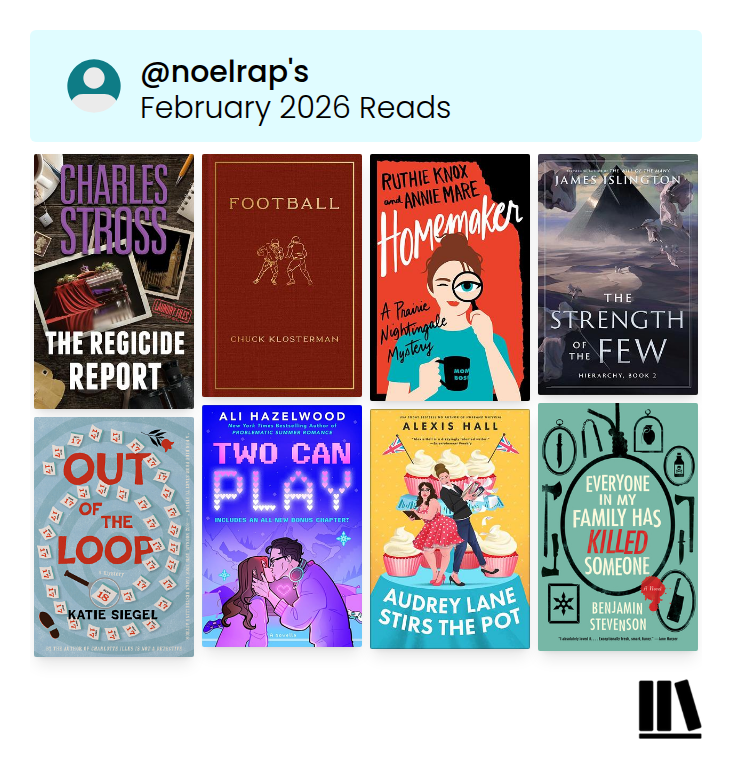
February 2026 Books of the Month
Posted on June 1, 2026
Listen · 14:03Continuing the month-by-month catchup that I started in January, here are February’s books. I read 8 and I think we’re going to talk about seven of them.
As one of those random things, the StoryGraph scores for this month as a whole were lower than January, even though my scores still remain pretty high. Something is up with my own scoring, because my average score is up significantly from last year, which means I’m doing some kind of weird grade inflation.
The Regicide Report — Charles Stross
StoryGraph Rating: 4.11 (2 of 8)
Rating: Single (6 of 8)
This is book umpteen gazillion in the Laundry Files, and the last in the line that follows the actual Laundry and Bob Howard and his ilk.
I always struggle with how to talk about umpteenth books in series. In this case, ever since the beginning of the series, we’ve known about Case Nightmare Green, the inevitable magical singularity that will doom humanity. Most recently, the Laundry have made a deal with an evil from beyond time to make that evil PM of Great Britain, because the alternative was somehow worse.
We also know, because this book is actually now a flashback as the series has continued forward in time, that the Laundry loses and the evil from beyond time continues to run the UK.
Which makes bringing Bob’s story to a satisfying conclusion somewhat challenging, since we know he loses. Stross, who is nothing if not committed to working out the logic of his worlds to their inevitable conclusion and beyond gives it the old university try here.
In book time, it’s 2014. The setup here is that Her Majesty, by virtue of her public position, is a huge storehouse of magical energy and some party or another is maybe trying to kill her to access that energy. Bob and his wife Mo, who by now are quite powerful magic entities in their own right, are tasked with security and keeping things from going totally non-linear.
Bob and Mo are still fun to spend time with, the series is getting a bit lore-heavy by this point, but I’ll forgive that in farewell book. Stross takes the 2014 setting to throw a few strays at British politicians who would become infamous in our timeline. The end is a little hampered by it’s just really hard to describe a battle between two multi-dimensional powerful beings and, again, a truly satisfying win has already been taken off the table. Still, I really this series and the way it parodied first spy tropes and then urban fantasy tropes and I’ll miss it.
Football — Chuck Klosterman
StoryGraph Rating 3.93 (3 of 8)
My Rating: Single (7 of 8)
Marketed as:
The marketing blurb for this book is lacking in hinges. Paragraph one: “A hilarious but nonetheless groundbreaking contribution to the argument about which force shapes American life the most. For two kinds of readers—those who know it’s football and those who are about to find out.” A lot to unpack there, not least of which is the idea that there’s some sort of ongoing argument to which the answer is “football”.
Later: “If Žižek liked the SEC more than he liked cinema, if Stephen Jay Gould cared about linebackers more than he cared about dinosaurs, if Steve Martin played quarterback instead of the banjo . . . it would still be nothing like this.” It’s like I always say, for your football book to succeed, you need to bring in the philosophy and paleontology fans.
I’ll be honest, I have no idea what’s happening here beyond some copywriter saying “I don’t know what to do with it either.”
Oh yeah, the book…
Long time pop culture essayist Klosterman with a series of essays on (American) football, a subject that he’s clearly obsessed with and also clearly wishes he was less obsessed with, which makes for an unusual tone for sure.
Like about everything I’ve ever read from Klosterman, it’s about 33% brilliant, 33% banal, and 33% unhinged (it’s not out of the question that Klosterman wrote the marketing blurb. I mean, he probably didn’t but it wouldn’t shock me).
Among the essays here:
-
There’s a discussion of why football is a good TV sport despite it’s obvious limitations. This happens to be a topic I think about frequently (generally, what makes a good TV sport) and his analysis here makes tremendous sense to me.
-
Later he spends pages explaining why he’s not weird for thinking Jim Thorpe is the greatest football player of all time, a position that, while I think many people would disagree with, is not some kind of unheard of claim, and is clearly kind of pedestrian given how Klosterman defines “greatest”.
-
There’s a discussion of violence in football that turns into — reasonably — a discussion of whether it’s moral to let people do dangerous things if they are popular. Fair enough, but Klosterman starts his argument with “first, we have to assume God doesn’t exist”, which is a big swing.
Homemaker – Ruthie Knox & Annie Mare
StoryGraph Rating: 3.73 (6 of 8)
My Rating: Double (5 of 8)
Marketed As:
I’m deeply shocked that this book doesn’t have a comparison in its blurb.
The Book:
Turns out I’m clearly replacing romance books with cozy mysteries.
We’ve got Prairie Nightingale, a single mom in Green Bay, Wisconsin. She’s about five years post divorce, and her divorce settlement allowed her to set up a trust fund to basically let her run her house like a small business, she’s hired a chef and a personal assistant and so on. About that time, she also outed a local doctor as a huge abuser and got him sent to jail. As a result, she’s somewhat on the outs with the local mom group, for reasons that frankly don’t reflect well on the local mom group.
Anyway, it’s a few years later and a local mom has gone missing and Prairie decides she’s uniquely suited to finding out what happened.
This book wears its heart on its sleeve — it’s full of women who are involved with men who abuse or diminish them in some way. It’s pretty upfront about what it’s trying to do and overall I found it worked. (The fact that the FBI agent on the case takes her seriously and is not another awful person goes a long way toward helping the vibes). Book one in a series, and I’m probably in.
The Strength of the Few — James Islington
StoryGraph: 4.28 (1 of 8)
Me: Double (2 of 8)
Book two of what the blurb calls “The Hierarchy quartet”, so I guess it’s a four book series? I can’t find another source for that, but let’s assume the publisher’s marketing is authoritative. (I was honestly hoping for a duology.)
This had been staring at me from the top of my Kindle TBR collection for about two months, and it was finally time.
One of my long-standing storytelling theories is “don’t split up the team”. Say you are telling a story about a team of five, and they split up. Now you are telling five stories, and each story gets 1/5th the time. It’s hard to do well.
In an unrelated story (but spoilery for The Will of the Many), or hero Vis is now split into three different people on three different worlds and turns out we go back and forth between the three viewpoints. It’s a 700 page book, so nothing is rushed, exactly. But it, for me, diffuses the tension somewhat.
There are three things that are broadly true here:
- The book is kind of slow going for a while, there’s a lot of pieces to move around the board, in fact there are three unconnected boards, so three separate versions of Vis learning what’s happening, it all takes a lot of space.
- This is the middle book of a series and it basically ends on three separate act breaks, one in each world. Not cliffhangers, exactly, and mostly the story beats for the book are resolved. Ish. But in a way that leads to more questions.
- Once the track is all placed and the train starts moving, it starts moving. The first book of this series never lacked for bonkers ideas and neither does this one.
The next book should be a doozy.
Out of the Loop — Katie Siegel
StoryGraph: 3.61 (8 of 8)
Me: Double (3 of 8)
Marketed as:
The marketing blurb for this is “The Seven Year Slip meets Vera Wong’s Unsolicited Advice for Murderers in this wholly original time loop mystery.” I’m assuming that the line being drawn here is that they don’t want readers to think the book actually takes place in the time loop, which is why I guess we don’t have “Groundhog’s Day meets Knives Out” or something like that (okay, one of the quoted blurbs is “Like Groundhog Day meets Memento” — it’s also got a quote from Mary Robinette Kowal, which is cool). I would love to have been in the meeting where they decided the cozy mystery comp to this book about a 28 year old woman would be a book about a 68 year old woman, but this is apparently why they don’t hire me to write book blurbs.
Anyway, Amie has a problem which is that she’s looped September 17th over 700 times. And when September 18th finally comes, she learns that her upstairs neighbor has been murdered. Amie decides to try and solve the crime, in part because she feels guilty for not stopping it any of the 700 times it happened.
Sometimes, I think a book has been crafted to specifically delight me. I could see this being too SF-weird for a mystery reader, and not SF enough for an SF reader (which I suspect explains the StoryGraph score). We never find out how or why the time loop happens, which is clearly the correct choice for this book. There’s also a romance plot with Amie’s ex-girlfriend Ziya.
And as a person who loves SF/mystery mashups, I really did eat this one up. The narrative voice is quirky: “A bent spatula sat between the two police officers, one of whom looked like he’d recently discovered that he’d been sitting on a spatula,” the character banter works, and the mystery is suitably cozy.
Amie’s time-loop experience does figure in the book, but not exactly in the way you’d expect. For one thing, coming back to the normal world after two years living the same day over and over is really, really weird, a part that Siegel explores nicely. You’d think that Amie is able to take her microscopic knowledge of all comings and goings on the day of the murder to figure out what happens, and that’s sort of true, but in an interesting way that is a more about how Amie’s own decisions affect other people than about her knowledge of the day. And I thought that was more satisfying. The mystery, romance, and character arcs all work together in this book nicely.
Audrey Lane Stirs the Pot — Alexis Hall
StoryGraph: 3.91 (4 of 8)
Me: Double (4 of 8)
This is the third book in Hall’s series about a UK baking show that is Legally Distinct from Bake-Off, with a host who is Legally Not Sue Perkins (though, to my ear, Hall does a heck of a job replicating her voice).
Our first main character here is the titular Audrey Lane, a small-town journalist who applied to the show on a lark. The other main character is Jennifer Hallet, the abrasive foul-mouthed show producer (as seen in the previous books). And you might think that there’s a bit of a grumpy/sunshine thing going on, but Audrey has a bit of a mouth on her too. There’s also a 92-year-old contestant who has a secret past.
This is fun, a little less fluffy than you think it’s going to be, and Hall does a nice job with the banter, it’s hard to do “insults that sound like flirting” but I think it really works here.
Everyone in My Family Has Killed Someone — Benjamin Stephenson
StoryGraph: 3.84 (5 of 8)
Me: Triple (1 of 8)
So, I’ve been pushing into mysteries more this year, and there’s probably a larger note about them as I learn what I do and don’t like.
Unsurprisingly if you’ve met me, witty meta-narratives generally work. I think I tried this one a couple of years ago and bounced off it for reasons I don’t remember. Anyway, after seeing a lot of recommendations, I tried it again, and I really liked it. (I genuinely don’t get the StoryGraph score here, this is a pretty acclaimed series as far as I can tell… And no, I really don’t want to read the actual reviews.)
Our viewpoint character, Ern Cunningham, writes guides about how to write mysteries, so he’s very versed in the rules of a fair play mystery. The book starts with them, and he references them continually. And, in fact, everyone in his family has killed someone. The odds are pretty good that Stephenson has a notebook somewhere with a list of all the ways you could kill someone and not have it technically be murder.
Anyway, this is in part an exercise how a narrator who continually insists on his own reliability can, in fact, be unreliable, but still fair. It’s a solid mystery on its own. Also, despite the meta hi-jinx, this book is pretty dark — the murder weapon is very creepy, some of the back story is rough. At a couple of points that tone mismatch between the back story and the lightness of the “it’s all a story” meta-shenanigans threatens to go off the rails, but I think it holds up at the end.