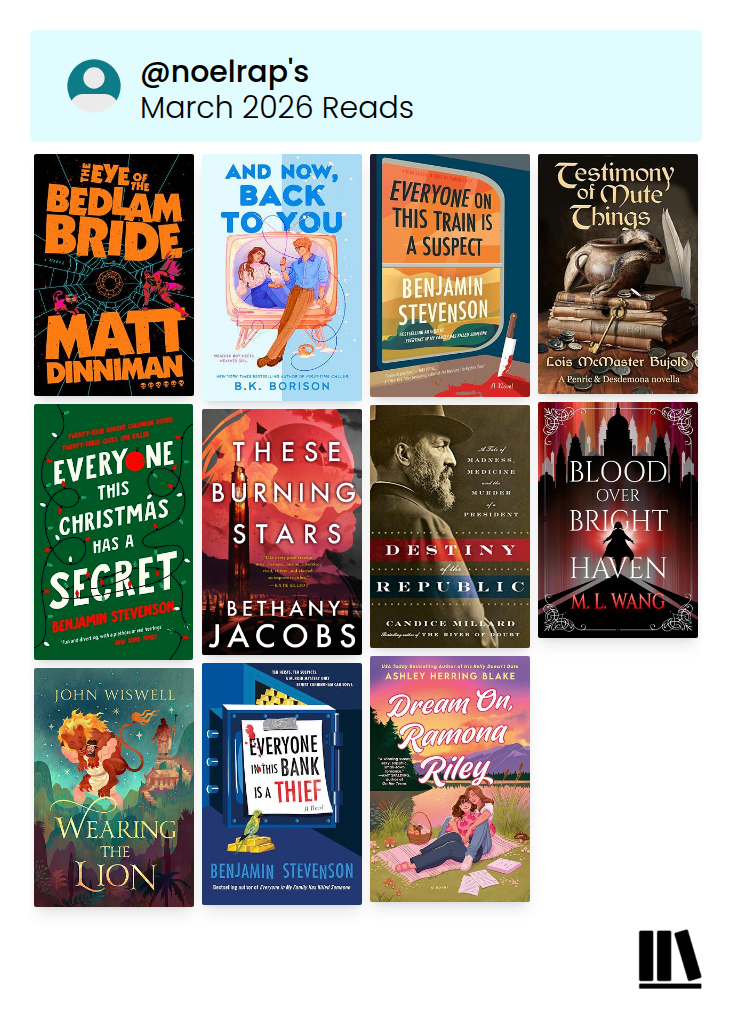
March 2026
Posted on June 7, 2026
Yep, we’re doing this again. I read 11 books in March and we might talk about all of them here, depending on how low in my own ratings I’m willing to go… StoryGraph scores are as of June 7, which should give you a sense of how averse I am to actually finishing anything I start these days.
Eye of the Bedlam Bride — Matt Dinniman
StoryGraph Rating: 4.53 (1st of 11)
My Rating: Double (3rd of 11)
Dungeon Crawler Carl, book six.
Look, I just need to admit it. I’m in on this, I’m along for the ride. I have no idea how Dinniman lands the plane, but I’m not sure how much it will bother me if he doesn’t.
I’m fascinated by books or movies that absolutely should not work but somehow do. This book, for example. The premise is notoriously hard to describe in a compelling way. The satire is broad and often a little crude, especially early. The series is set up so that each book has the same fundamental plot (solve the puzzle, beat the level). The first book is likely objectively the weakest of the bunch, and if it’s not the second book is.
And yet… It’s still really compelling, even as Dinniman writes 700 page books, and even as I genuinely wonder how this ends well.
And Now, Back to You — BK Borison
StoryGraph Rating: 4.15 (6th of 11)
My Rating: Single (7th of 11)
Marketed As:
“Two competing meteorologists are forced to find common ground in this opposites attract, When Harry Met Sally inspired romance, from #1 New York Times bestselling author B.K. Borison.” The When Harry Met Sally reference here, presumably is code for “one of them is really uptight and the other one is not” because otherwise the two works have basically nothing in common. Like, I think the defining features of WHMS are that they are opposites and that they have a long time relationship and try to be friends. This book… is not that.
What it is, is a sequel to Borison’s First Time Caller, it was set up quite explicitly in that book. Our radio station’s very organized meteorologist is sent off to work with the bubbly, klutzy meteorologist of the neighboring TV station.
This book is as tropey as you can get, as our two leads are shipped off to the wilds of western Maryland to cover a huge snowstorm. Do they get snowed in? Is there a mix-up that leads them to have to share a room? A room where there is Only One Bed? Does he learn the value of spontaneity while she learns the value of structure? Do they have an embarrassing incident that is accidentally broadcast live?
To quote John Rodgers, “You say trope, I say well-honed narrative tool”. Overall, the book reads great while it’s going, I had a fun time. The characters have some more depth beyond their tropes, and they are actually trying to accomplish something together outside the romance plot.
There isn’t a third-act breakup, which is nice, but both main characters have an antagonist, and they are both cartoonishly awful, and we never really get any motivation from either of them, and we also don’t really get a satisfying defeat of either of them, which does make an otherwise kind of nice ending feel like it falls a little short.
Everyone on this Train Is A Suspect — Benjamin Stephenson
StoryGraph Rating: 3.93 (7th of 11)
My Rating: Double (4th of 11)
Everyone this Christmas Has a Secret — Benjamin Stephenson
StoryGraph Rating: 3.77 (11th of 11)
My Rating: Single (6th of 11)
Everyone in this Bank is a Thief — Benjamin Stephenson
StoryGraph Rating: 3.93 (8th of 11)
My Rating: Double (5th of 11)
Marketed As
- Train: “fiendishly fun locked room (train) murder mystery in the spirit of Murder on the Orient Express.”
- Christmas: “If Knives Out and The Thursday Murder Club kissed under the mistletoe.”
- Bank: “perfect for fans of Richard Osman and Anthony Horowitz.”
Osman is the writer of Thursday Murder Club and Horowitz is the writer of a mystery series where he inserts himself as the Watson figure, which honestly I just checked it out of the library on that description, so I think the bank quote wins as the most accurate descriptor. Murder on the Orient Express just means “this takes place on a train”, Knives Out means “funny and a lot of people liked it and we hope that rubs off”. (Really, so does Thursday Murder Club).
The Books:
Here’s the thing about murder mysteries. For a genre that is nominally so grounded in reality, the simple fact is that the very idea of a fanciful crime being solved by an amateur is outlandishly fictional. It has, as far as I can tell, never actually happened. (Even fanciful crimes with clues being solved by professionals seems quite rare in reality.) I first came to terms with this reading Scott Westerfeld’s So Yesterday, where a character goes to the police specifically because she knows that amateurs never solve crimes on their own…
Anyway, these are the sequels to Everyone in My Family Has Killed Someone, and it’s fair to say that since I read three of these in a month that I’m in on this series. I actually liked all three of these a little better than the original. What they lose in some of the bits about mystery rules applying they gain in the fact that Ernest has now in-universe published Everyone in My Family and everybody in the books knows that Ernest is trying to apply mystery rules and the books have a lot of fun with that. They are also all a little less tonally all over the place, they are not as dark as the deaths in the first book.
In the train book, Ern has been invited on a train that is hosting a mystery fan convention, and eventually one of the guests of honor dies. Many mystery tropes are deployed. (I personally like the bit where Ern says that the rule is that the killer needs to be mentioned by name and asserts that the killer’s name appears 106 times in the book. He periodically posts updates of name counts…).
Book three applies the meta-detective schtick to a “holiday special”, a novella in which the detective learns the true meaning of Christmas, in a bit that I thought was quite clever.
Book 4 is a bank heist. Or rather, multiple overlapping bank heists. It is still clever while also being different from the other books. There’s at least one thing that happens where the author’s note insists that it could theoretically happen and then admits that “theoretically” is doing a lot of heavy lifting, so, fair, warning, I guess.
Testimony of Mute Things — Lois McMaster Bujold
StoryGraph Rating: 4.18 (5th of 11)
My Rating: Single (7th of 11)
Book, like, 15 in the Penric and Des series. They are all good, if all a little slight. This one is out of chronological order, much earlier in the timeline, for some reason.
These Burning Stars — Bethany Jacobs
StoryGraph Rating: 4.23 (4th of 11) ‘
This is a book where the StoryGraph rating was part of what pushed me to actually read it…
My Rating: Double (2nd of 11)
Science Fiction! On Spaceships! This is part heist/con story, and part revenge drama, and part watching high-functioning sociopaths at work. Guess which part I liked best.
We have a government controlling a small handful of star systems linked by jump gates. Our main characters are Esek, nominally a cleric but also one of the sociopaths; Chono, who is less nominally a cleric and less of a sociopath; Jin, a hacker/grifter; and Six, the other sociopath. For reasons, one of the first thing that happens in the book is that Esek, for no particular reason, humiliates Six when they meet — Six is a student, Esek is a cleric looking for talented novices. Most of the rest of the book is basically Six’s revenge in one form or another.
The world-building here is genuinely interesting, there’s a persecuted minority group that is involved in the manufacture of the fuel for the jump gates, they were nearly obliterated seventy-five years prior, and this resonates through the entire story. (Their name – “Jevani” – seems like a near-portmanteu in ways I’m not completely comfortable with…)
This is also A Book With A Twist. It’s a pretty good one, and Jacobs hides the card there skillfully enough that I had to go back in the book and check that she had, in fact, hidden the card. The thing I can say is that the ending of the book suggests a much different plot structure needed in the second book.
Destiny of the Republic — Candice Millard
StoryGraph Rating: 4.38 (3rd of 11)
My Rating: Triple (1st of 11)
This is a pretty great narrative non-fiction. Short and focused, and by being focused avoids a lot of the pacing issues that can happen in narrative non-fiction. Not a biography of James Garfield, it’s the story of his shooting and the subsequent medical malpractice leading to his death.
Some quick notes:
- The assassin, Charles Guiteau, was familiar to me from the “Assassins” soundtrack, where he is somewhat sane-washed. His type of delusional narcissism feels sadly really familiar — these days they probably would have made him Ambassador to France
- If for nothing else, it’s worth reading for the portrayal of Garfield as a genuinely admirable person who came from the most abject poverty imaginable to the Presidency, and who seems to have been much less of a competitive jerk than many others who have held that office.
- Also Chester Arthur, who as Vice President was a national joke but who seems to have somehow risen to the occasion and into the office.
- I haven’t seen the Netflix show yet, but it’s very much on my radar..
There’s not much of an alternate history hook here, though I suspect that a healthy Garfield would have won re-election, in reality Arthur did not get (or fight for, really) the nomination (he had health issues), and the Republican candidate, James Blaine, lost to Grover Cleveland. It’s not hard to think that Garfield could have won that election had he lived, but also it’s not clear to me what the downstream consequences would have been.
Wearing the Lion — John Wiswell
StoryGraph Rating: 3.86 (9th of 11)
My Rating: Walk (9th of 11)
2026 Nebula Award Nominee
This is, and this is going to sound judgy in a way I don’t mean, the American Sitcom version of Greek Myth. There are hi-jinx and shenanigans.
I have about 4000 things to say about this book, which I don’t think I loved, but I can at least say was interesting. This is a retelling of the story of Heracles, it’s almost worth thinking of it as a secondary world fantasy that has a lot in common with Greek myth.
The book splits viewpoints between Hera and Heracles, with the catch being that Hera hates Heracles from the jump because he is the product of one of Zeus’ adventures. Heracles, unaware, prays to Hera and just assumes her favor, no matter what she tries to do to him. Eventually, she goes too far, and the rest of the book is about recovering from that mistake. (Well, it’s about Hera hiding the mistake from Heracles, and then recovering from it.)
This is a book about grief, and anger, and not being defined by your worst day. Like Wiswell’s last book, it’s also about who gets described as a monster. It’s also about found family, in this telling, rather than slaying all the mystical beasts in his labors, Heracles befriends them and they share adventures together, so we wind up with Heracles, the Hydra, the Boar, the Hind, and so on traveling the world together. It’s honestly bananas.