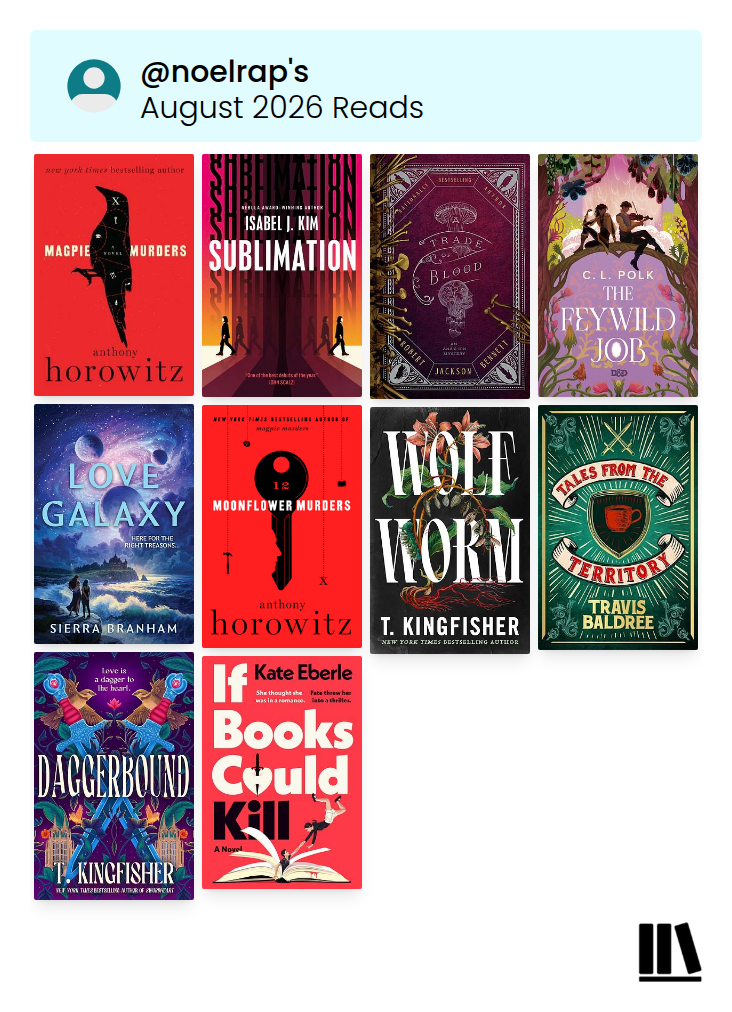
August 2026 Books of the Month
Posted on October 23, 2026
Welcome to August, I read ten books this month and we’re going to talk about eight of them, I think, though if you catch me sometimes offline and want to talk about Travis Baldree’s AI story, I might take you up on it.
I’m particularly unsure in my own ranking this month, a lot of disparate things that had good qualities but also significant flaws, which are probably the hardest things to force-rank.
Magpie Murders – Anthony Horowitz
StoryGraph Rating: 3.88 (8th of 10)
My Rating: Single (6 of 10)
Sometimes I dabble in fiction writing, though I’ve never finished anything longer than a short story in my adult life. There are a lot of reasons for that, none of which reflect particularly well on me. One of them, though, is that I think I lack the sheer chutzpah.
I’m on kind of a Horowitz kick, I guess, for metafictional puzzle mysteries. This book is metafictional in a totally different way than the Hawthorne series. I think it’s best to go into this book kind of cold, but the setup is that we start with an editor about to read the latest novel from her star mystery author.
We then get about 200 pages of that novel, basically straight up, cover page, copyright, we’re reading the inner novel. Until we stop. Because the novel is missing its final chapter, the one that comes after the detective announces that he knows what happened. And then…, well, the author turns up dead, and that’s another mystery and I don’t really want to spoil this.
I was super into this for about the first 250 pages, and I’m not sure the ending lived up to it. (In particular, it hinges on the idea that an author with millions of puzzle-loving fans could hide something in plain sight for years, and I’m dubious. To be more cryptic, even I figured out kind of where the puzzle was, and if I had stopped to try and really solve it for five minutes, I would have.) Other than that, though, it’s a master class in how to dribble out information in a mystery.
That said, I don’t know what the heck is up with the StoryGraph ratings, this is a novel that won awards, was turned into a highly-regarded BBC series. I’m guessing it just broke containment, but the mystery of StoryGraph mystery ratings continues.
I’ll also note that the idea of a popular author who hates his fandom, longs to be taken seriously as a serious writer and tries to publish a mean and sour satire of modern Britain… boy that sure suggests a different name, though the person I’m thinking of got her mean and sour satire published.
Sublimation – Isabel J. Kim
StoryGraph Rating: 3.86 (9th of 10)
My Rating: Triple (2 of 10)
Marketed As:
The cover blurbs are from R. F. Kuang and John Scalzi, which is quite a pair, and honestly, not a bad “for fans of” pair. Also “for fans of Severance”, which I think is self-evident from the book’s premise — literally 100% of the people I have described this book to have said, “oh, like Severance”. I take that all to read “deals with identity”, “especially cross-cultural identity”, “is a serious book”, “but not, you know, that serious”.
This is the first book I’ve read in a while that is, for lack of a better term, Hugo bait (by analogy to Oscar bait), I’d be floored if it doesn’t get award nominations next year. Kim is a Nebula award winner for her short story “Why Don’t We Just Kill the Kid In the Omelas Hole”, the book is blurbed by Mary Robinette Kowal, it’s got Prestige TV streamer vibes. (The book was pretty buzzy, and I am guessing that the low SG rating here is somewhat that it also broke containment, I’m pretty sure that it’s not going to be for everyone.)
The setup here is disarmingly simple. In this world, when a person crosses a border with no intent to return, they “instance”, meaning that they split into two people. One version goes ahead and one person stays behind. If, at some point in the future, the two instances touch, they are “reintegrated” or turned back into one person with shared memories.
This is what we call a killer premise. It’s easy to explain, has metaphorical and emotional depth, and also room for fun SF business figuring out how this would work legally, historically, and artistically.
Of course, you have to turn a even a killer premise into an actual story.
Our first set of viewpoint characters are Soyoung and Rose, Rose instanced from Soyoung as a child when her mother moved from Seoul to New York City, and they have had no contact for 20 years. We also have Yujin and YJ, YJ was surprised to instance when he left Seoul for college in NYC ten years ago. That pair talk constantly. As we start, the Korean originals are close friends, the NYC instances have never met, and Rose is called back to Seoul for her (their?) grandfather’s funeral.
There are three parts to this book – a character story about our 2 or 4 lead characters and how the various instances interact, a corporate espionage story about technology surrounding instancing, and a bunch of asides about how instancing works physically, legally, and culturally, including how some famous pieces of culture are different in this world.
Without getting spoilery, I thought the character story was interesting, the corporate story was interesting but a bit underbaked, but the two interact well, the personal story definitely informs the corporate story and vice-versa. The asides vary a lot, but the best of them are very thoughtful about how the concept of instancing would play out metaphorically in, say, The Odyssey. Overall, the concepts played out in a way that made the book more than the sum of its parts.
What I think makes this book really work is that it combines the “what is my identity” and “what if I made different choices” and “what does it mean to have freedom to make choices” and “who should make choices” aspects that are all kind of implied by the premise. There’s a lot going on.
A Trade of Blood – Robert Jackson Bennett
StoryGraph Rating: 4.56 (1st of 10)
My Rating: Triple (1 of 10)
Book Three of The Ana and Din Mysteries
Sometimes I get book titles stuck in my head to the tune of song lyrics. “Ana and Din”, of course, is to the tune of “Anna Begins” by Counting Crows.
This series is, if not totally unique, at least quite special. There have been oodles of fantasy and SF mystery books, for sure, but I can’t think of another series where the world-building was quite this elaborate. Often a mystery plot in an F/SF novel is just an excuse to explore the entirety of the fictional world, since detective work is a good excuse to be able to wander both high and low status places. That’s true here, for sure, but it’s true at the series level as much as, if not more than, at the book level.
This series takes place in a world where the Empire exists to hold back what are basically annual Kaiju attacks. To this end, they have learned to do wondrous things with the use of the Kaiju (okay, “Titan”) blood, using it to fashion people and creatures with amazing powers and abilities. The first book took place near the outer sea wall which is the first line of defense, the second book concerned a facility that processed Titan blood. This book takes place in the seat of the Empire’s beef district, critically providing food from enormous enhanced cows. (The author, I note, lives in Texas…)
Above and beyond the mystery plots, these books are about the idea that, although the Empire is burdensome, somewhat corrupt, and absurd, it beats the alternative of having Kaiju rampage the landscape every year. (Crucially, the Empire is not corrupt enough to compromise its own safety. Yet.) It sure seems like Bennett is giving us a tour of the critical features of the Empire toward some deliberate end — we’re also getting directionally closer to the center of the Empire.
This time around, Ana and Din are called to investigate what seems like an obvious case, the daughter of one of the top families is found dead, and the son of the other top family is found running from the scene with blood on his hands. Really, Ana is called there to somehow prevent the two families from going to war and jeopardizing the food supply of the entire Empire. Naturally, there’s more to the case that meets the eye, and as it usually goes in this series, the eventual problem is creepy in the extreme. Bennett’s ability to create the technology in this world and then show how it might be misused is genuinely outstanding.
This book is less… swampy than the previous two, though there’s still plenty of body-horror to go around. Maybe I liked it a tiny hair behind the other two in part because I think there’s a hair less Ana (that might be in my head), and also because the ending is maybe a hair less satisfying. These are quibbles, this is one of the best fantasy series going right now and if you haven’t read it yet, you should.
Love Galaxy — Sierra Branham
StoryGraph Rating: 4.14 (5th of 10)
My Rating: Double (5 of 10)
Marketed As:
At the top, we get “Smart, sexy, compulsively readable and fun, this is for fans of Everina Maxwell’s Winter’s Orbit and Arkady Martine’s A Memory Called Empire” then at the end of the blurb, we get “Sexy, snarky, and revolutionary, this fast-paced thrill ride will hook lovers of reality TV, fans of thoughtful sci-fi, and anyone who lives for drama.” It’s nice of them to do my job of breaking down what the comps actually mean, though I personally think they didn’t need to say “sexy” twice, especially for a book that — SPOILER ALERT — contains no actual sex.
Winter’s Orbit is an SF romance novel and gets you “arranged wedding with royal intrigue”. A Memory Called Empire is a mystery/intrigue book with deep world building, and I swear if they only used that as a comp because this book also has a (completely different) Empire I am going to throw something across the room. Not the Kindle. Something squishy. Actually, and to my genuine surprise, “person with the title Ambassador investigates a murder against a backdrop of imperial intrigue” more or less describes both this book and A Memory Called Emperor, though the surrounding stories are quite different. All three books have same-sex couples, so that’s another comp.
So, what I originally thought was a kind of weird combination actually does describe this book quite well, 10 points for the marketing department.
We’re set up in a galactic empire which has all the modern comforts including reality TV. Once a generation, the flagship show, Love Galaxy, does a Very Special Season where the heir to the throne chooses a bride. It’s all politics, of course, but the point of the show is to put a veneer on it so that the population will be invested. This year’s Love Galaxy is special because there are twin heirs, Prince Nix and Princess Spie, who will both be choosing spouses.
We’ve got two POV characters here — Spie herself, and Temmi (short for Artemis). Temmi is a poor, desperate woman from the literal butt end of the Empire, and through a series of accidents, she winds up as her planet’s representative to Love Galaxy.
The first, like, 40 percent of this book is trope-y as hell. Nix is the responsible academic one, Spie the free-thinking brash disappointment. Temmi’s planet is mistreated by the empire. Temmi is not used to dressing fancy, and she’s cynical but overwhelmed by being off planet. Temmi is there for Nix but falls for Spie. Both Nix and Spie are charmed by Temmi’s lack of airs. It’s not bad, it’s pretty well done, but definitely is edging more towards the lighter side.
Then — this is a mild spoiler but it is in the blurb — a contestant dies. And we immediately jump into a very good middle third of the book or so where it is both a reality TV parody and a paranoid political thriller — “I’m not here to make friends” taken to extremes, and then the last third of the book goes all into political thriller setting up a second book (I can’t seem to find out if this is a duology or a trilogy).
I liked this quite a bit — a lot more than I would have expected based on the title (I don’t remember where it was recommended to me, but the relatively high SG ratings were a factor in picking it up). The mystery plot was well done, I was genuinely surprised by the twist. I will note the end is more of an act break than a novel ending. The author had a chance at the end to do an annoying thing to ostensibly add tension to book two, and she did not do that, which I appreciated — there’s no shortage of tension for book two as it is.
Moonflower Murders — Anthony Horowitz
StoryGraph Rating: 3.96 (6th of 10)
My Rating: Double (3 of 10)
Y’know, since I’ve been doing these mystery rabbit holes, for the first time in about a decade, my top-read author for a calendar year won’t be Seanan McGuire. This is my fourth Horowitz book this year, and I don’t see how I skip the third book in this series, so he’ll probably be the top slot.
What gets me about this book, again, is the sheer audacity of it. This is the second in this series of meta-mysteries, and it inverts the setup of the first book. To simplify slightly, our heroic editor, Susan, is approached by a couple who claim that their daughter solved a murder that happened eight years ago. The claim is she solved the murder from clues hidden in Atticus Pünd Takes The Case, a mystery written by the same annoying author whose death was the subject of the last book in this series. She’s now gone missing, so they ask Susan to read the book and see if she can’t figure it out.
Pulling back. This is a 600-page book, meaning that it is basically two full mystery novels. On top of which the inner novel must meet the following constraints:
- It must be a satisfying mystery in its own right
- The characters all need to be recognizably based on the characters in the outer mystery
- There must be findable clues to the identity of the outer mystery’s criminal
- It must be clear why the daughter, and only the daughter, figured it out from the clues
- It must also be clear why the author, having solved the outer mystery, didn’t just tell the police at the time
Somehow it does that, and the bit where the penny finally drops and we see all the clues is pretty great.
Wolf Worm — T. Kingfisher
StoryGraph Rating: 4.16 (4th of 10)
My Rating: Single (7 of 10)
Kingfisher — Ursula Vernon — writes in many distinct modes. There’s the fantasy rom-com, the modern creepy horror, the Gothic horror, some YA. It’s a wild mix. This one combines the late 19th century period feel of the Sworn Soldier books with the body horror of some of her modern stuff in a sort of Gothic, definitely creepy, don’t read while you are eating lunch kind of book.
Our heroine is Sonia, a down-on-her-luck scientific illustrator. It’s 1899, and she’s accepted a job illustrating insects for a naturalist who lives in a crumbling mansion ten miles from the nearest town in North Carolina. She settles in, despite the fact that the setup has more red flags than Moscow on May Day. (Back when there was a USSR… you know what, on further reflection, if I have to explain a quip, it might not actually be necessary…)
Sonia quickly learns that there have been disturbing things happening in the woods — “blood theifs” is the local phrase. Also, her employer was involved in some sort of disturbing events that led to the previous illustrator (who was also his wife), leaving for parts unknown. There’s a mysterious shed and some disappearing chickens, and it’s all unsettling before we get into the parasites and insects of it all.
I, like, personally, enjoy Kingfisher’s non-creepy stuff more than the body horror. Which is not to suggest anything about this book, it’s very well done, and Kingfisher uses her own illustrator skills to help draw the main character, so to speak.
Dagger-bound by T. Kingfisher
StoryGraph Rating: 4.53 (2nd of 10)
My Rating: Double (4 of 10)
This is Kingfisher in her romantic fantasy mode which means a few things:
- The characters will be delightful
- There will be multiple small clever fantasy ideas that are brilliant but which are tossed off along the way
- The plot will be mostly an excuse to get the two lead characters into the kind of scrapes that happen in a rom-com-adventure-fantasy
- The Temple of The White Rat
So, I will say that I’m pretty sure you could read this standalone and pretty much get it, but it does build on characters from pretty much all the other White Rat books. Our Main Character is Edmond, some seven years after Clockwork Boys, the other main character is The Dervish, who’s an enchanted sword and former partner of the last enchanted sword, from Swordheart. (For what it’s worth, it was clear pretty early on that this was not Edmund’s first rodeo, but I didn’t remember Clockwork Boys well enough to have that resonate in the book at all. Kingfisher does a perfectly good job of making sure you have the relevant information.
In some ways, the book mirrors the plot of Swordheart — person and enchanted weapon meet accidentally, person has to complete a task, danger arises, they slowly fall for each other and solve the danger. It’s different in feel, partially because The Dervish is a different character than Sarkis, but mostly because we’re now multiple books in here, and the world is more built out, so there are more pre-existing fun concepts to play with.
Two things kept this in double range instead of triple range. There’s a surprisingly large amount of railway to lay down to get this train on track — it’s like page 285 before we finally get to the White Rat temple, and some of that does have the feel of “this is here so that can be there later on”. And, while the character ending is satisfying, there’s a key plot beat that goes by kind of quickly.
But really, there’s a limit to the downside of a book that contains sentences like, “The sun rose, probably”. I saw a comment on Reddit or something to the effect that Kingfisher doesn’t seem to ever get the most out of her plots. I kind of see it, but I’d look at it from the other side — Kingfisher gets the absolute most out of hanging out with her characters.
All that said, what I want more than anything in this series is a book that actually centers on the White Rat people doing White Rat things, by which I mean having a terrifying amount of system and emotional intelligence. I want to see them Cordilia Vorkosigan their way to solving five problems simultaneously with one clever ploy. I know Kingfisher has it in her…
If Books Could Kill — Kate Eberle
StoryGraph Rating: 3.94 (7th of 10)
My Rating: Single (8 of 10)
Marketed As:
“A NOVEL LOVE STORY meets LOVE IN THE TIME OF SERIAL KILLERS in this rom-com following Roxie Mitchell, an adventure-loving romance reader who finds herself trapped in a meet-cute turned murderous” — Let’s break that down… A Novel Love Story is one of Ashley Poston’s magical realism rom-coms, where the character gets caught, Schmigadoon-style, in the town that is the setting for her favorite romance series. Love in the time of Serial Killers is new to me, seems to be a romcom where the main character is a true-crime devotee. So I’m getting meta-fictional romance crossed with true crime.
The general rule for novels is that if the stakes are important to the characters, they will be important to the reader. This means that you don’t need every book to be about the end of the world, you just need the characters to react as though what happens matters to them.
This poses a problem for meta-fiction. If the character suspects that the story is governed by the rules of fiction, how can you get that character to care about what happens? In some of the meta-mystery books this year, the problem is solved because the mystery is still life-threatening even if the character is using story logic to solve the puzzles. It’s tricker, I’d imagine, in romance novels, how do you get a character to fall in love if the character thinks it’s all a series of manipulation tropes?
Which brings us to Roxie, in her late twenties, somewhat aimless in life, but who reads romance novels to experience what she says she doesn’t want in her real life. Roxie makes an offhand wish to be the heroine of her favorite romance writer’s next book. That wish is granted (just go with it), and Roxie has a meet-cute with the perfect guy. It’s only after the guy tries to stab her that she discovers that her favorite romance author is trying to stretch herself by writing a thriller novel.
Oops.
She then meets Grant, a professor who is a crime novel devotee, and commandeers him as a native guide to the world of crime thrillers. One thing that I think is fun about this book is that the inner novel that Roxie is living through is clearly not supposed to be that good, though obviously the stakes are high for Roxie. Roxie and Grant wind up having various adventures as it turns out Roxie’s attempted killer is part of something larger. I enjoyed it, there’s a twist at the end that I’m maybe 75% on board with. Well, there’s two twists at the end, the inner book and the outer book, the inner book one is absurd (see, “the inner book isn’t supposed to be good”) the outer book one is… well it’s not not absurd. It’s also probably necessary for the end to work.