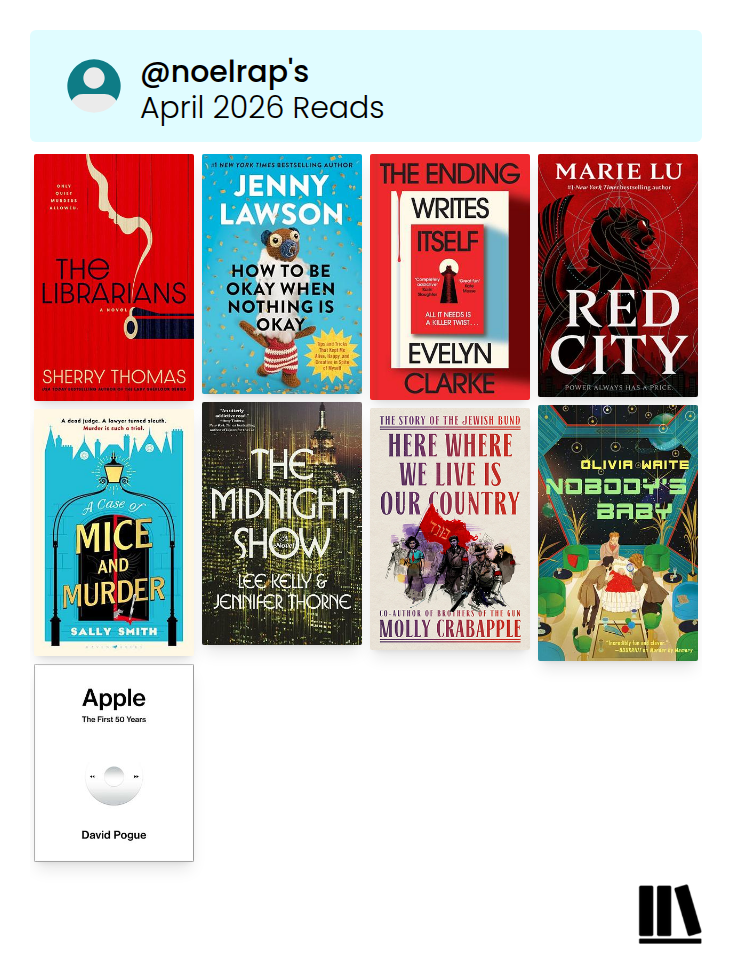
April 2026
Posted on August 8, 2026
I read nine books in April and we’re going to talk about all of them. Warning: wild swings in tone ahead, as we go from some fairly light books to at least one very, very dark book.
The Librarians — Sherry Thomas
StoryGraph Rating: 3.51 (9th of 9)
My Rating: Single (8th of 9)
This was the book that got me interested in comparing StoryGraph ratings to my own, because it looked like the gap between my Single (which I enter as 4.25) was so different than the StoryGraph rating, but it turned out that the rankings were nearly identical (in part because this was a pretty good month for books).
Still, that’s a low SG score for a book I basically liked. Usually, when there’s a gap like this it means one of the following:
- The book is weird in a “not for everybody” way, but it clicked with me (like Remember You Will Die)
- The book has a clear flaw that I’m overlooking because I liked the rest of it so much.
- It does seem like mysteries have tougher scoring or are more divisive, though I can’t quite prove that.
- The book “escaped containment” and has been exposed to people not part of its natural audience (an award nominee, for example). Conversely, it’s a later book in a series, the haters have left and only the fans remain.
- There’s a huge disconnect between the marketing and the actual book and people came to it with incorrect expectations.
This book is a mystery, but also last one — it’s marketed as a thriller — the US cover is wildly misleading, though the actual blurb is better. And it’s not really that. There is a murder, and there is a mystery. But if you are looking for the normal rhythm of “I, the detective, am going to uncover puzzle piece after puzzle piece to solve this conundrum”, this isn’t it.
This is much closer to a workplace drama or found-family story. Our main characters all work together in a suburban Austin library. All four of them are hiding something in a mostly benign way, but the deaths of two people who attend a game night at the library disrupt their lives. They do wind up solving the mystery but the book is more concerned with how they all learn to live with their past mistakes and trust each other. (Thursday Murder Club is not a terrible comp, but this book is not as funny.)
I had some technical problems with it – the book goes back and forth in the timeline to keep the reader in suspense and it’s a little annoying, and I’m still not sure I completely understand what actually happened with the McGuffin. But I did like the characters and went into “book, don’t you dare harm one hair on this amazing person’s fictional head” mode, so it was successful in that way.
How To Be Okay When Nothing Is Okay — Jenny Lawson
StoryGraph Rating: 4.26 (3rd of 9)
My Rating: Single (5th of 9)
I’m not sure how much I have to say about this one. Jenny Lawson, known online as The Bloggess, has written a few memoirs about dealing with her particular set of mental health issues. This is more of a self-help book, in that it’s a list of small things you can do to improve your day, your work, your outlook, what have you.
It’s fun, I suspect it’ll be genuinely helpful, and her voice remains inimitable.
The Ending Writes Itself — Evelyn Clarke
StoryGraph Rating: 3.67 (8th of 9)
My Rating: Single (9th of 9)
Marketed As:
The blurb includes stuff like this:
“it will remind you, in the best way, of Agatha Christie” — Stephen King
Now, I am but a simple reader and no Stephen King, but I tend to read “it will remind you of Agatha Christie” as “fair play mystery”, which this is decidedly not. I suppose that’s not the authors’ fault.
The setup here is that six different mid-list writers are called to the remote island castle of famed mystery writer Arthur Fletch. When they arrive, they discover that Fletch is dead, with one last chapter of his last book unfinished, and the six of them are in a contest to finish the chapter with a million dollars and another million dollar advance on a book deal to the winner.
Remote island, mystery writer, motive all over, this is very tropey. And I don’t think it’s much of a spoiler to say that the writers start dying. However, and this is more of a spoiler, it’s more of a thriller/horror than a mystery — nobody solves anything, we just figure it out when there are two people left standing and one of them is trying to kill the other one.
What it is more than anything is a chance for Clarke (pen name for authors V. E. Schwab and Cat Clarke) to satirize the publishing industry. All the characters have been chewed up by publishing in one way or another, and none of them come off particularly well. (There’s a bit about how YA loves a young author, which is particularly biting given that Schwab sold her first novel before graduating from college).
I’m not quite sure what to make of this at the end of the day. As a thriller, it’s a little oddly structured. (At least two of the characters relive childhood trauma, but it feels coincidental?) As a satire, it’s obviously knowing but a little mean to the writers, in a way that feels strange coming from authors that escaped mid-list. It’s clever, though.
Red City — Marie Liu
StoryGraph Rating: 4.16 (4th of 9)
My Rating: Double (4th of 9)
Marketed As:
“The Godfather meets The Magicians…Perfect for fans of V.E. Schwab” (speaking of V.E. Schwab…).
“Godfather meets the Magicians” isn’t bad actually, “The Magicians” is maybe a little on the nose, but it’s accurate. I’m not completely sure why V. E. Schwab is catching strays here, my best guess it that it’s a signifier for “here’s a popular author who writes books that feel a little like YA novels, but with sex”?
The real missing comp here is Jade City, and not because the names are similar, but because that’s the “Organized Crime, but with Magic” series of the last decade. Hold that thought…
And Another Thing Or Two
There’s a thing in SF/Fantasy where sometimes it’s easier to describe and have the reader accept a big change than to accept a small change.
If you wanted a world where left-handedness was, like, half the people instead of 10% or whatever it actually is, you’d struggle to explain it because it’s not weird to the characters and it’s unlikely to come up organically. Whereas, for a fantasy magic system, you often can just have the character explain whatever physics-bending they are doing and nobody blinks.
In an unrelated story, in this book, Los Angeles is “Angel City”, New York is “Gotham”, and London is “Londinium”.
Next… I think this might be a Gail Simone observation, but I could be wrong. In the DC comics universe, many mythological figures canonically actually exist, including, say, the Greek gods, and the Fae. As fun as this is to play around with, a side effect is that a number of ideas and stories that in our world are the product of human imagination, in the DC universe are not, because the supernatural beings actually exist.
In an unrelated story, in this book, Zeus was an alchemist. Shakespeare, as well. Basically any person from the past famous for exceptional deeds was an alchemist.
Oh, Yeah, There’s a Book
I should talk about the actual book. Our main characters are Sam and Ari. They meet as somewhat isolated children, forming a friendship where they somehow become very emotionally reliant on each other despite never learning basic facts about each other’s lives. In the fullness of time, they are each secretly inducted into rival crime/alchemy syndicates, each trying to control “sand”, an alchemical drug that makes people into more perfect versions of themselves.
There’s honestly a lot to unpack here. Alchemists are given work names that are passed from generation to generation — he’s Shakespeare, she’s Mozart (but not that Mozart). And to oversimplify a bit, eventually they are both asked to kill each other at about the same time they each realize the other is an alchemist and that they are both the hotshot young talents of their respective teams. But are they still attracted to each other?
Tale as old as time and all that, and I suppose all the above sounds a bit harsh. I really did like it — the magic system is cool and the magic battles are notably well written, interesting, and actually followable. There’s a lot that works on a scene-by-scene basis. I have some quibbles about the plot structure as a whole (a couple of actions at the end are maybe not motivated, the ending is maybe less climactic than advertised).
I will note that for a universe that is basically our universe with renamed cities and a magic drug that makes people super-smart and charismatic, there doesn’t seem to be that much different about the society? On like page 382 a character idly muses about all the great advances that sand has wrought and how it has been transformative. I would have liked to have seen more of that.
Sequel, April 2027…
A Case of Mice and Murder — Sally Smith
StoryGraph Rating: 3.96 (6th of 9)
My Rating: Triple (3rd of 9)
Not everybody can re-invent a genre, somebody has to be there to just work in the genre.
1901 London. Our detective is one Gabriel Ward, a barrister (or solicitor, I can never tell the two apart. He’s one or the other and probably would be mortally insulted if I gave him the wrong title). He’s brilliant, and I think we can safely say neuro-atypical coded, and very content to live a life of routine inside a genuinely real UK institution where all the lawyers live (the Inner Temple). And then one day the Lord Chief Justice of England shows up on his office doorstep, quite dead and also quite barefoot.
That’s the murder part. The mice part is to do with Ward’s current case, a tricky copyright dispute over a children’s book called Millie The Temple Church Mouse.
Anyway, this is a straight-up mystery novel, something of a change of pace after reading a bunch of meta-mysteries, thrillers, and whatnot.
It’s a quite well-structured one. Ward is well-suited to be a reluctant detective — he’s preternaturally well-read, and has a lawyer’s eye for piecing together a system. He’s also been sort of shut out of the world, and the case re-convinces him that he can be a part of it. You could imagine that being handled quite badly, but here it works, and is quite sweet in spots. Sticks the landing quite nicely.
I liked this one a lot. I often struggle with historical mysteries, but this one is really good.
The Midnight Show — Lee Kelly
StoryGraph Rating: 4.14 (5th of 9)
My Rating: Triple (2nd of 9)
Marketed As:
Interestingly, it’s not marketed in relation to other books at all, even though the Taylor Jenkins Reid fan in your life will probably love it.
Note one: It’s interesting how framing a book as a series of interview transcripts gives you a certain license to do particular kinds of foreshadowing. Like the kind of thing where the narrator drops hints about the future and it’s often insufferable in a regular book works quite well here in a fake-interview structure because both the interviewer and interviewee can quite naturally share context that the reader lacks.
Note two: It’s always interesting to me in a historical story that intersects with known reality where the authors choose to use real people and where they choose to use fictional famous people. In this particular book, it’d also be interesting to list which real people clearly either don’t exist or didn’t have careers in this book. Or which real people have clear fictional analogues. (Harrison Ford exists in this world, the entire original SNL class doesn’t, Lorne Michaels has a clear analogue).
Note three: It’s sort of an unexamined trope of mystery stories (which this is, kind of), that characters can just flat-out lie or omit things to the detective like sociopaths even if they aren’t actually sociopaths.
This book is about Lillian Martin, who is Legally Not Gilda Radner from The Midnight Show, which is Legally Not Saturday Night Live. In this universe, TMS premieres in 1980 and is the fresh new comedic voice of a generation. (Which is why I say SNL presumably didn’t exist.) Martin goes missing, presumed dead, after a Valentine’s Day show in 1983.
Forty years later, a noisy reporter starts asking questions — most of this book is interview transcripts from her notes.
So, without doing spoilers, I think the book does a great job on character work, often juxtaposing two different characters’ opposing views of the same event. I think it does a decent job of managing expectations. Again, without spoilers, there’s a thing you clearly think is a possible solution to the mystery that the book explicitly shuts down early on. There’s a very cool character reveal late in the book that is the kind of thing that you can only pull off in the faux-interview structure. It’ll be a killer moment in the inevitable six-episode streaming adaptation.
Again, trying to avoid spoilers, the book spends a lot of the back half presenting two different and mutually exclusive interpretations of what Lillian and the people around her did leading up to her disappearance. I think that becomes untenable as one side becomes clearly delusional, and that happens maybe about 15 pages earlier than you’d want it to happen.
But overall, very charismatic book, a lot of fun, satisfying ending.
Apple: The First 50 Years — David Pogue
StoryGraph Rating: 4.48 (2nd of 9)
My Rating: Single (7th of 9)
This is one of those books that I kind of wonder who the actual audience is, which is I suppose a weird thing to say about a book I paid genuine money for. But, as long-time Apple person, I’m not sure I learned a lot, and at the same time, I think it’s not quite pitched for the causal non-Apple fan in your life. That said, this is the biggest StoryGraph - my ranking gap of the month, so it clearly found an audience.
Apple, of course, has one of the weirdest stories in the history of American business. Honestly I think Pogue is at his best when writing about the period after Jobs left and before he came back — the early part is very well covered territory, and the later part, I guess also is in a different way. (I’m biased here because my 1995 internship was right at the end of that Jobs-less period.)
What I think Pogue does nicely in covering the middle part is make it clear just how dire Apple’s situation was while also giving the people involved their due for their actions that helped set up what Jobs was able to do when he got back. In this telling, Apple was chaotic and teetering on the brink basically from about 1982 when Apple 2 sales started slowing down until really, the launch of the iPod in 2001. Jobs leaving is just a comma in that chaos, not the dividing line.
The iPod is when Apple finally figured out an answer to the question of “can we find a way to get a mass audience to pay a premium for a well-designed product”. (The iMac was just a low-end computer — it sold enough to keep the company going, but didn’t change the trajectory of the company)
After Jobs dies, the book becomes sort of a dull listing of each new product and how it came about, and I’m not sure that, say Apple Fitness deserves it’s page and a half, and I use Apple Fitness every day.
Here Where We Live Is Our Country — Molly Crabapple
StoryGraph Rating: 4.58 (1st of 9)
My Rating: Triple (1st of 9)
Boy did this one bring up a lot of feelings. Very clearly the best book I read this month. Strong contender for book of the year, it’d be the first non-fiction book I ever felt that way about. It’s astonishing. Not an easy read at all, though.
This is the story of the Bund, the Jewish socialist party/organization that existed throughout Eastern Europe from the late 1890s until Ashkenazi Jewish culture was obliterated. This is my culture. I don’t know a lot of family lore, but I’m pretty sure I have a relative in my great-grandparents’ generation who came here directly fleeing a military draft.
This is not a happy story of a scrappy organization that overcomes obstacles to eventually achieve a victory. Or a moral victory. This is the story of a group of organizers, both idealistic and practical, who were systematically destroyed. Who were eventually slaughtered by their enemies from the right, but also by their enemies from the left, and also from other Jewish factions, all enabled by the general indifference of the world at large. Critically, the story of the Bund is not just the story of progrom and holocaust, but also of community and solidarity. Of course, the story of Jews in Eastern Europe in this time is necessarily violent. Violence is a background note of the entire history.
It’s a measure of something that I keep trying to calibrate that last paragraph to make it less angry even though my anger is justified and even though you should see what I cut from that paragraph.
Anyway, the important through line of this book is the tracing of a conception of a Jewish place in the world that does not involve a Jewish state – here where we live is our country. From the beginning the Bund and the Zionists were at odds. The Bund basically saw the early Zionists as reactionary and delusional, not to mention feeling that the Zionist project reinforced the idea that Jews were not a part of Europe. The people who would become the first government of Israel do not come off well in this book at all.
Nobody’s Baby — Olivia Waite
StoryGraph Rating: 3.94 (7th of 9)
My Rating: Single (6th of 9)
Marketed As:
Perfectly cute cozy SF mystery — it’s blurbed as “Becky Chambers meets Miss Marple”, which credit where credit is due, that’s pretty spot on.
We’re on a generational ship, though in a slight twist, nobody really dies because their memories get stored and uploaded into new bodies. It’s got pleasant small town vibes, this is not a ship harboring a deep dark secret. Which is why when a baby pops up, it’s a mystery. It’s cute, there’s not enough cosy SF in the world.