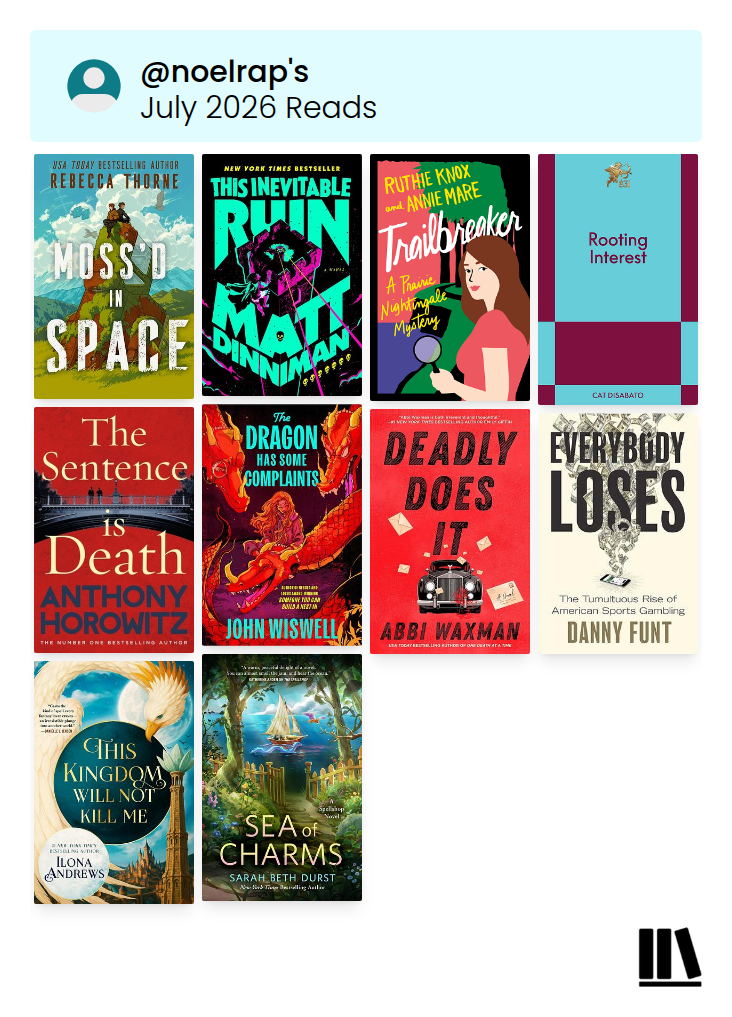
July, 2026
Posted on October 22, 2026
Let’s see… 10 books in July, and we’re going to talk about… at least eight of them.
Moss’d In Space – Rebecca Thorne
StoryGraph Rating: 4.37 (4th of 10)
My Rating: Double (4 of 10)
Marketed As:
“a brand new cozy science-fiction romance series for fans of Martha Wells.” Congratulations to Martha Wells on reaching blurb comparison status. This is specifically meant for fans of Murderbot, of course, it’s got a vaguely similar cozy-adjacent, sentient non-human with trauma issues vibe. But it’s not like Raksura fans are necessarily going to flock to this. (To be fair, Thorne specifically says in the author’s note that she had the idea after reading Murderbot.)
That said, what this book really felt like to me is Rebecca Thorne’s take on Becky Chambers’ Wayfarers series, in kind of the same way that Can’t Spell Treason Without Tea is a take on Legends & Lattes, and I do not mean that as a dig at all. I like the Tea and Tomes series more than the Legends & Lattes series, and I am for sure in favor there being many, many books that are tonally similar to the Wayfarers books, possibly my favorite book series of the last ten years.
But we’ve got a kind of ramshackle spaceship, a person looking for their place in the world, humans in a very subordinate position to aliens (with a political split in the human population), making friends along the way. Moss’d is less episodic than Long Way to a Small, Angry Planet and maybe has a little less acid in it, but there’s a lot of similarity.
Maybe I should mention the book itself outside of the blurb. Our hero is Torian, a former smuggler who buys the cheapest ship in the shipyard to raise enough money to save her sister from her chronic illness and not in any way to get back at her ex. The ship is an alien leftover, and its life support system is the titular moss, a sentient plant with real abandonment issues after being stranded on a lowly human space station for over a century. They have adventures.
This book scores something like an 8 or so on the Cozy Scale from last year. It hits pretty much all the marks, especially if you like snarky sentient plants. I genuinely would love to see much more cozy and cozy adjacent SF. The only thing really keeping it from rating higher is that the ending is more of an act break, there’s clearly some unfinished business to come in future books.
This Inevitable Ruin – Matt Dinniman
StoryGraph Rating: 4.56 (1st of 10)
My Rating: Single (6 of 10)
Dungeon Crawler Carl Book Seven
Well, as predicted, we’ve reached the stage where I read this book with an open bookmark to a fan wiki. Also, based on the StoryGraph scores, we’re clearly at the point where basically just the fans have stuck around, so the average is high.
I think I’ll save large amounts of comment until I actually catch up on book 8, but a few thoughts:
- Basically, this series has reached the point where I know I’m hiring this book for 800 pages of a particular kind of chaos, and whatever else you might say about this book, it sure delivers that.
- I can now kind of dimly see where I think the plot is going eventually, or at least what it would take for Carl to “win”, but I’m not sure how that ends up a satisfying character story?
- One thing that makes the book chaotic is that Dinniman does a particularly good job of giving the non-Carl characters agency and planning. Both Carl’s enemies and his nominal allies have their own plans and disrupt Carl pretty regularly.
Anyway, I found this one a little less focused than the last two – not shocking in that it’s about a battle with at least 10 different factions (I have to admit, I at best only barely understand the outside-dungeon politics and AI stuff), but I was entertained.
Trailbreaker – Ruthie Knox, Annie Mare
StoryGraph Rating: 3.97 (8th of 10)
My Rating: Double (5 of 10)
The second book in the Prairie Nightingale series, cozy-adjacent mysteries set in and around Green Bay, Wisconsin. Truthfully, a major plus for me on this one was that it takes place in Door County, where I vacationed just weeks ago, and major scenes take place in recognizable areas that I visited, which certainly makes visualizing the action fun.
The Sentence Is Death – Anthony Horowitz
StoryGraph Rating: 3.87 (9th of 10)
My Rating: Single (9 of 10)
Another second book in a mystery series, this one is Horowitz’ series where he self-inserts as the Watson to a Holmes like detective, answering the musical question, “what if Sherlock Holmes was an even bigger asshole”. I can’t really talk about my reaction to this book much without spoiling the plot, suffice to say I was out-twisted by Horowitz, which is the main reason why I would continue this series.
The Dragon Has Some Complaints – John Wiswell
StoryGraph Rating: 4.02 (7th of 10)
My Rating: Triple (1 of 10)
Marketed As:
“This cozy fantasy intertwines epic battles with loving friendships, sharing an utterly unique perspective on what it means to be a “monster.””
I’ve got a lot to say about this one and actually that marketing quote is a good frame, but we’ll start with saying that it’s one of my favorite fiction works of the year, I liked it much better than Wiswell’s last two (and since one of them won a Nebula, that’s saying a fair bit). I’m honestly surprised that the SG rating is that low (though admittedly there were a lot of high ranking books this year), and I wonder what fans of Wiswell’s other books didn’t think they got from this one, because to me it felt like he was dialing in very precisely on his themes from his past couple of books.
Having a perspective on what it means to be a “monster” is very much the plot of Wiswell’s last two books (Wearing The Lion and Someone You Can Build a Nest In), but is much less an explicit focus of this one. Our viewpoint character is a dragon (technically, one of the three heads of a dragon), but there’s relatively little here about people thinking dragons are monsters. The dragons are underestimated a little, and they are fierce war machines, but not monsters the way that the last couple of books have thought about monsters.
This book is much more invested in responses to trauma and the three-heads as a reification of mental issues (once, in the past, they were a four-headed dragon…), and in chronic pain and disability. Also in fighting for the cause of inclusion and diversity. So, it’s got a lot on its mind. Minds.
You’d think that “cozy fantasy” and “epic battles” wouldn’t be in the same book, and that’s kind of a by definition, epic battles aren’t cozy thing. This book is not cozy the way that, like, The Spellshop or Keeper of Magical Things is cozy. The stakes are existential for our characters, and there is violence and trauma and sex.
This book is more like Goblin Emperor, or Long Way To A Small, Angry Planet, or House in the Cerulean Sea (though that book has less violence), or even In Other Lands or the Tomes and Tea books. There is violence, but the books aren’t about violent people, they are about the effects of violence. There are stakes, but they are about people working together and building community against those who would tear down community. (Not all these statements apply equally to all these books.) While reading this, it seemed tonally to me to be most similar to House in the Cerulean Sea (it’s very different from House on the Cerulean Sea).
My only real quibble is that the plot structure of the last third is a little odd (the character story structure works fine). This is a book that understands that subtlety and not-subtlety are both tools in the craft, and knows when to use one or the other.
Deadly Does It – Abbi Waxman
StoryGraph Rating: 4.09 (6th of 10)
My Rating: Single (8 of 10)
Mason and Mann Mysteries, book 2
Look, I don’t want to oversell this. I like Waxman’s writing style a lot, it’s funny and breezy, and she is one of only a very few writers that I read that put actual jokes in the narration. That’s a pretty good SG rating for a mystery, though.
When last we left our heroes, Mann, who is a former movie star turned lawyer, had hired Mason to be her assistant. In this book, they are asked by Mason’s AA sponsor to investigate some threats she (the sponsor) has received. Matters escalate, and eventually there’s a murder. And look, this is not a puzzle mystery. Even I basically figured out what was happening, and I never figure out what’s happening. This is a chance to take two characters you root for, surround them with charming quirky helpers, and watch them banter their way through a mystery plot. It’s a wildly effective formula if you get the banter right, and this book largely does.
You know that Waxman is hoping for the long haul here because Mason gets an emotional beat/conclusion at the end of the book that really only makes sense to spend time on if we’re going to keep revisiting Mason’s growth as a character.
Anyway, fun book. Like a lot of mysteries, the plot critically depends on at least one character lying like a rug and being basically an undiagnosed sociopath, but again, that’s like 50% of all TV mystery episodes, and this book would make a solid TV series.
Everybody Loses – Danny Funt
StoryGraph Rating: 4.26 (5th of 10)
My Rating: Single (7 of 10)
One of my annual entries in the “lets read a non-fiction book that will enrage me”, this book is a history of the rise of sports betting in the US since it was legalized in the mid 2010s. (I would have been interested in reading a longer-term history of sports gambling, but that’s not the book).
It’s well-written, well-researched, and Funt obviously has opinions. I’m not sure there’s an entire 300 page book worth of story here, or at least the story that is here is depressingly repetitive: here’s a way in which this industry is predatory, here’s evidence they know that they are being predatory, here’s the person trying in vain to call attention to it, here’s where the problem just gets worse.
Duncan Sabien coined the term “Social Dark Matter”, and I think my understanding of the term shows a little drift from the original article, but the idea is that personality traits that have an incentive to be hidden are far more prevalent than you expect, and when they become socially acceptable seem to explode in popularity. To me, the “dark matter” analogy also means that these traits sort of quietly in the background affect a lot of the way society runs. In an unrelated story, the numbers that are presented in this book for things like percentage of people who are sports betting, percentage of sports bettors who wind up with significant, life-threatening depression, and the like, are truly terrifying.
This Kingdom Will Not Kill Me – Ilona Andrews
StoryGraph Rating: 4.42 (2nd of 10)
My Rating: Double (3 of 10)
Marketed As
We’ve got a two-fer here: “Outlander meets Game of Thrones in this blockbuster new epic fantasy series” and “For fans of Samantha Shannon, Danielle L. Jensen, Sarah J. Maas, and isekai and portal fantasy”. I am… not familiar with those names (well, other than Maas, the name I recognize, but I’ve never read her books). One moment please. Oh – Samantha Shannon of Priory of the Orange Tree and other weapons-grade fantasy books, Jensen’s books are not familiar to me, but they look like romantasy. Is there a kind of isekai that is not portal fantasy? (No.) I read… I think the first two books of Game of Thrones before bouncing off, and Priory of the Orange Tree, but not its sequels. But overall, “person got isikai’d into Westeros” is not a bad description.
The absolute most similar recent book is Long Live Evil – LLE is funnier and more meta, this book has more elaborate world building. (For people who are, like, very old, it reminded me of the Guardians of the Flame series, in that it is also about a person who comes to a fantasy world and starts trying to make the world a better place.)
Anyway, our hero is Maggie, who wakes up one morning in a ditch by the side of a road in what she immediately recognizes as her favorite fantasy series. Armed with nothing more than a perfect recall of the books, and the ability to resurrect after death, she sets about trying to avoid the dystopian fate that her books fortell. Naturally, she accumulates friends, foes, and knowledge.
I liked this a bunch, the “started from nothing” trope works on me pretty well, and the progression of the plot works. I especially like Maggie’s attitude – she decides that she’s there to save and help people, and does so even when it would probably be prudent not to. (I mean, it does all work out for her, which is where the author’s intent becomes a superpower.)
I have three quibbles:
- There are a lot of characters and it’s hard to keep track of them, especially since characters have a tendency to pop back in 300 pages after an incidental mention.
- The ending is a cliffhanger, which is fine, but the actual story resolution… I think that the order of the beats here should be “defeat the villain’s plot” then “discover the villain was only a pawn in a bigger villain’s game”, not vice-versa, you drain some of the satisfaction.
- I do wonder about the book series that Maggie nominally falls in love with that is this world. I mean, on a meta level, this book is much less concerned with why Maggie is there or how this happened than Long Live Evil (at least so far). But at a different level, Maggie is deeply in love with a book series featuring the total collapse of a kingdom and the horrific deaths of several of her favorite characters (and where the final book has been long-delayed). Actually, maybe those Game of Thrones comps were closer than I thought…
Sea of Charms – Sarah Beth Durst
StoryGraph Rating: 4.40 (3rd of 10)
My Rating: Double (2 of 10) Honestly, this is a toss-up with This Kingdom Will Not Kill Me
Marketed As
“a cozy fantasy romance” – sometimes you just have to go with the classics.
This is the third book in the Spellshop series, another friends-to lover romance against a very, very cute fantasy background. While it’s common for romance series to have different books focusing on different couples, one thing about this series is that all three (soon to be four) books all happen at the same time. This book starts with the same incident as The Spellshop and we have scenes from both other books that duplicate but are from the opposite point of view.
You have to kind of admire Durst’s commitment to populating her world here with maximum cute adorability. This is a spoiler-y, but:
- Cats in this world fly
- We have a Marmoose, a huge fluffy creature created to help people
- A dragon in this book hoards music. (I will say that the idea that a dragon might have a conceptual hoard rather than a physical one is pretty great.)
- People in this book have skin color all across the rainbow and beyond, our main character in this book is silver, there’s an island where everybody is pastel. Our secondary character has beautiful crystal horns. In this way – and only in this way – it reminds me of the Raksura books.
- We’ll get more of the magical cheese shop next book, I’m pretty sure. (The next book is entitled The Magical Cheese Emporium, so that’s not exactly Holmes-level deduction…)
I could go on. This book, like the last two, is at least a nine on the cozy meter.